
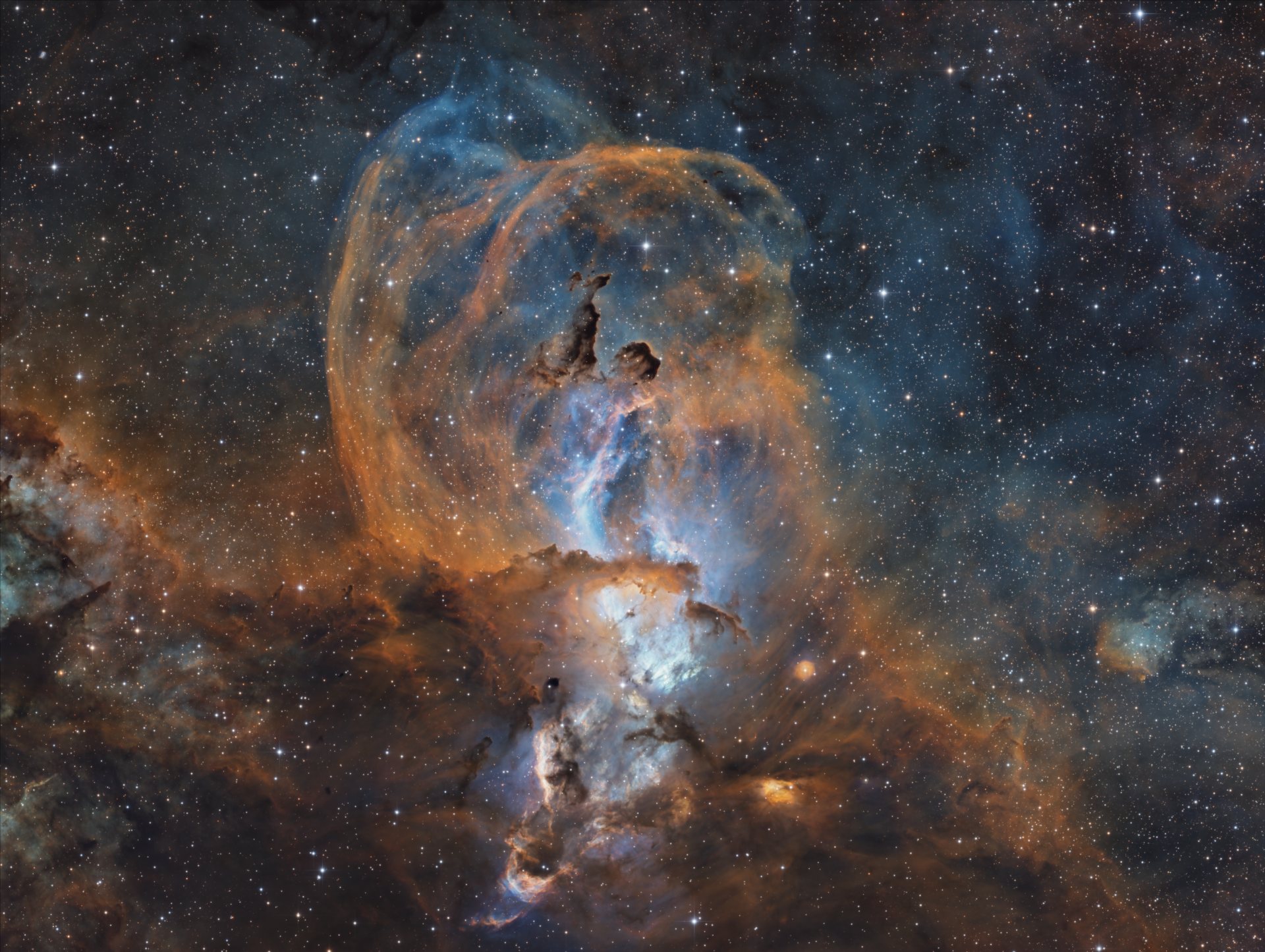
Statue of Liberty Nebula (NGC 3576)
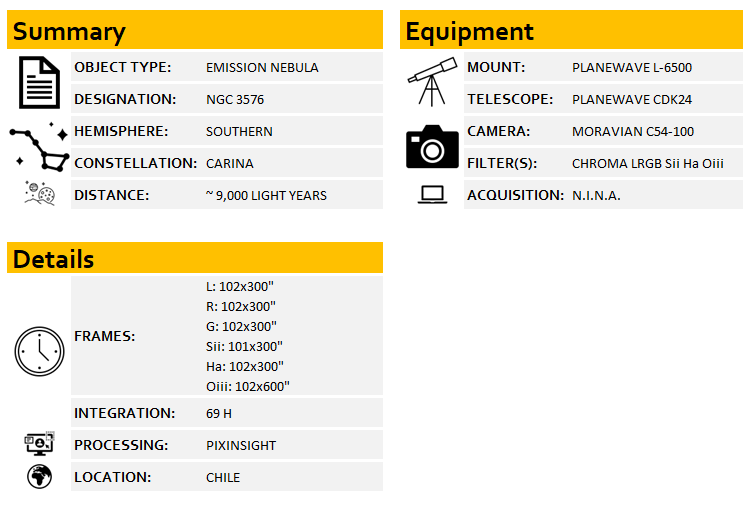
This image is the result of ShaRA Project #12. The data for NGC 3576 was collected by our team member, world-renowned astrophotographer Vikas Chander, using his personal setup in Chile. Read the full ShaRA article here.
Cosmic Sculpture: The Statue of Liberty Nebula
Situated deep within the southern constellation of Carina, NGC 3576 is a luminous and turbulent emission nebula located approximately 9,000 light-years from Earth. Often referred to as the Statue of Liberty Nebula due to a central structure resembling the iconic monument, this remarkable region is among the most dynamic and studied stellar nurseries in the Milky Way. Discovered by John Frederick William Herschel in 1834, NGC 3576 has since become a key object in the exploration of massive star formation, molecular cloud dynamics, and stellar feedback mechanisms.
The Nature of an H II Region
NGC 3576 is classified as an H II region, a type of emission nebula formed from vast clouds of ionised hydrogen gas. These clouds are energised by ultraviolet radiation emitted by newly formed, massive OB-type stars, causing the gas to glow brightly in visible wavelengths. The intense radiation, along with powerful stellar winds, sculpts the interstellar medium, carving cavities and driving shock waves through surrounding material. “Massive stars profoundly influence their environment, generating powerful winds and ionising radiation that shape the evolution of star-forming regions.” (NASA, Chandra X-ray Center). Spanning nearly 100 light-years across and appearing about 35 by 15 arcminutes in the sky, NGC 3576 is one of the most prominent features in southern sky surveys.
Star Formation
One of the defining characteristics of NGC 3576 is its vigorous star formation activity. Infrared and radio observations have unveiled numerous protostars embedded within dense filaments of gas and dust. Using near-infrared imaging and spectroscopy, astronomers have identified over 30 massive stars in various evolutionary stages.
These stars illuminate the nebula and drive powerful feedback mechanisms. Their winds and radiation compress surrounding clouds, often triggering new waves of star formation. “Massive stars act as cosmic engines, igniting the birth of new stars while dispersing and reshaping their birth clouds.” explains the European Space Agency. This phenomenon, known as triggered or sequential star formation, is a hallmark of complex star-forming regions. It exemplifies how one generation of stars can catalyse the birth of the next.
Chemical Composition
NGC 3576's chemical fingerprint reveals much about its environment and evolutionary processes. Like other H II regions, its spectrum is dominated by hydrogen emission lines, especially H-alpha, but it also shows strong emission from ionised oxygen, nitrogen, helium, carbon, and neon.
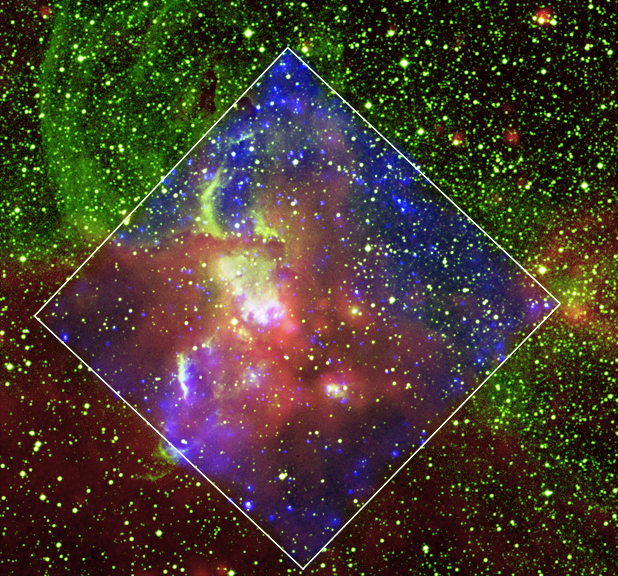
One particularly fascinating component is the presence of polycyclic aromatic hydrocarbons (PAHs), complex organic molecules composed of carbon and hydrogen. These molecules form in the cooling envelopes of dying stars and are considered precursors to prebiotic molecules essential for life. According to NASA's Spitzer mission: “PAHs may represent one of the earliest stages in the formation of life-supporting molecules in the Universe.” Their detection in NGC 3576 suggests active organic processing, driven by the nebula’s intense ultraviolet radiation field.
Bok Globules: Seeds of Future Stars
Adding to the region's intrigue are numerous Bok globules: compact, opaque clouds of gas and dust silhouetted against the bright emission backdrop. These are believed to be embryonic star-forming clumps, where conditions may eventually lead to gravitational collapse and the birth of protostars.
Owing to their opacity, these objects are difficult to study in visible light, but Bok globules are vital for understanding the initial conditions of stellar formation. They are miniature laboratories of cosmic evolution, governed by interactions between gravity, turbulence, magnetic fields, and thermal pressure.
Magnetic Fields
Magnetic fields, while invisible to the eye, play a critical role in the evolution of star-forming regions. In NGC 3576, near-infrared polarimetric imaging has enabled astronomers to map the structure and orientation of magnetic field lines. These fields appear to be aligned with filamentary gas structures, suggesting a degree of order and influence on the cloud’s morphology.
Studies indicate that magnetic pressure contributes significantly to supporting clouds against collapse, making magnetic fields active agents in regulating star formation efficiency and the fragmentation of molecular clouds. Astrophysicist Alyssa Goodman described magnetic fields as: “scaffolding in a building—largely unseen but essential to the structure’s integrity.”
Energetic Insights from X-ray Emissions
NGC 3576 has also drawn attention in the X-ray regime. Observations with NASA’s Chandra X-ray Observatory reveal diffuse X-ray emissions emanating from the region. These emissions arise from shock-heated plasma, likely caused by high-velocity winds from young stars and perhaps the remnants of earlier supernovae.
These X-rays are essential for understanding the energy budget of the nebula, including how massive stars inject heat and momentum into their surroundings. This stellar feedback is responsible for reshaping the cloud’s internal structure and potentially halting or triggering subsequent waves of star formation.
The Future of Exploration
Looking ahead, next-generation observatories such as the James Webb Space Telescope (JWST) and the Square Kilometre Array (SKA) will enable even more detailed investigations into regions like NGC 3576. These instruments will probe deeper into the infrared and radio regimes, revealing embedded structures and chemical processes that remain hidden to current optical telescopes. As technology advances, NGC 3576 is expected to yield new insights into the formation of stars, the chemistry of life’s building blocks, and the role of feedback in shaping galaxies.
Observing NGC 3576
NGC 3576 is a favourite among astrophotographers and observers located in the Southern Hemisphere, where it appears high in the night sky during the late summer and autumn months. Situated in the Carina constellation, it lies near celestial landmarks such as Eta Carinae and the Carina Nebula complex, a rich region of interstellar wonder.
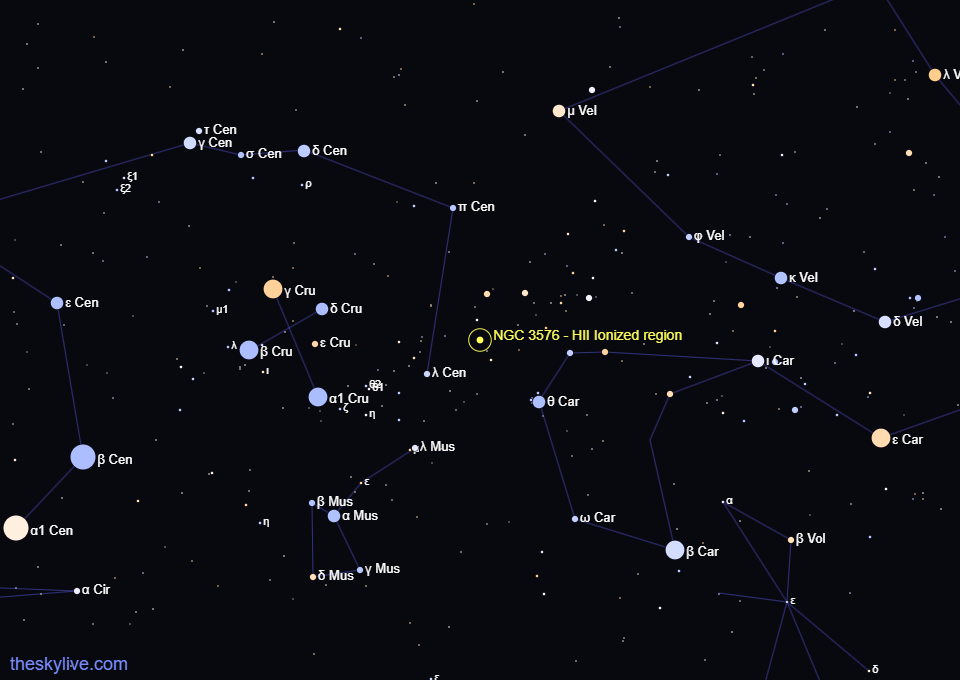
To find it, one can trace a line from the Southern Cross through the dense star fields of the Milky Way's central band, where NGC 3576 rests close to the galactic plane. The optimal viewing window is February through May, when the nebula is highest in the sky after dusk. Under dark skies, long-exposure imaging in narrowband filters—particularly H-alpha, Oxygen III, and Sulfur II—reveals intricate details and dramatic colour contrasts. Instruments such as the VISTA infrared camera have also captured hidden star-forming cores veiled by dust, providing a deeper layer of insight into this region.
Reference List
- Chandra X-ray Observatory (NASA). Massive Star-Forming Region NGC 3576 (Gum 38a).
- European Space Agency (ESA). Star Formation and Feedback. ESA Science & Technology Portal.
- NASA/IPAC Extragalactic Database (NED). NGC 3576 Data and Spectra.
- NASA Spitzer Space Telescope. Spitzer Detects Organic Molecules in Star-Forming Regions.
- Science@NASA. Magnetic Fields and Star Formation.
- Goodman, A.A. (2012). Magnetic Fields in Star-Forming Clouds: The Observational Perspective. Nature, 490(7421), 273–276.
- Povich, M.S. et al. (2007). A Multiwavelength Study of the Star-Forming Region NGC 3576. The Astrophysical Journal, 660(1), 346–363.
- Urquhart, J.S. et al. (2013). The RMS Survey: Star Formation in the Southern Milky Way. Monthly Notices of the Royal Astronomical Society, 431(3), 1752–1770.
- ESO - European Southern Observatory. VISTA Views Star Birth in the Carina Nebula.
- Reipurth, B. (2008). The Formation of Stars and Planets in Bok Globules. In Handbook of Star Forming Regions, Vol. II. ASP Monograph Publications.
- Simpson, R.A. et al. (2012). Magnetic Fields in NGC 3576 Revealed by Near-Infrared Polarimetry. Astronomy & Astrophysics, 539, A10.
- NASA JWST Science Team. Future Observations of Massive Star Formation.
- Rathborne, J.M. et al. (2004). Triggered Star Formation in NGC 3576. The Astrophysical Journal, 610(2), 822–833.