
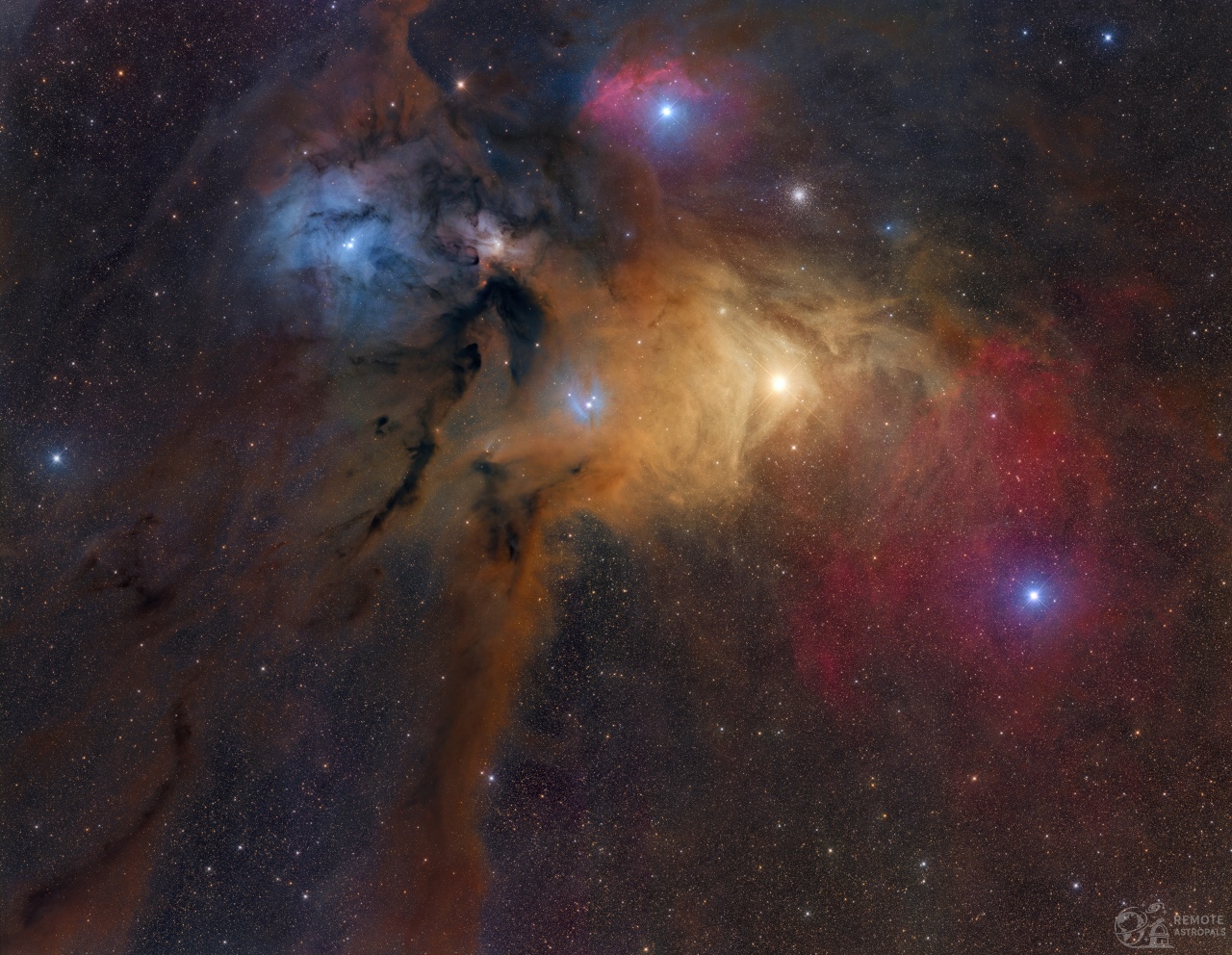
Rho Ophiuchi Molecolar Cloud
In a Nutshell
Molecular cloud complex with dark, reflection, and faint emission nebulae
Rho Ophiuchi cloud complex + LDN 1688, LDN 1689, IC 4603, IC 4604
Southern
Ophiuchus
~445 light-years
Technical Details
Takahashi Epsilon 160ED
10Micron HPS1000
QHY 600 SBFL (Sony IMX455 CMOS sensor)
Astronomik LRGB DeepSky
97 h
Chile
Remote AstroPals' Project III – Rho Ophiuchi
Remote AstroPals’ third project explores the Rho Ophiuchi cloud complex, one of the closest and most diverse star-forming regions to Earth. This area combines reflection, dark, and faint emission nebulae with dense molecular clouds and embedded young stars: a rewarding but challenging photographic target.
This 97-hour dataset was generously provided by our friend and member Attila Kaptas, using his high-end setup in Chile, under excellent dark-sky conditions. The image is built from eight stitched panels — our largest dataset to date. It was so large that we had to abandon our initial plan to process it in drizzle 2, as the resulting mosaic reached a resolution of 21,626 × 17,061 pixels, producing an enormous file size. Every script or process took half a day or more, and completing the full processing required several weeks of work.
Gradient correction was also challenging. With so much dark nebulosity in this region, the line between signal and gradient was hard to define, this is where all the individual interpretations become more evident. To ensure a smooth integration of everyone’s work at the end, we agreed to process from a single stitched master panel, which Massimo and Aldo kindly prepared for the entire team.
As in our previous project, data quality was outstanding and gave plenty of room for all members to create their own interpretation. The range of processing approaches, from subtle natural-colour renditions to more contrast-driven versions, all contributed to a final composite that is both cohesive and distinctive, but most of all, unique.
For Project III we had the pleasure of welcoming new members: Marcella Botti, Samuel Müller, Thiago Gilberto Do Prado, Nick Fritz, Noemi Leon, and Guenter Kleinschuster. Their contributions have added fresh perspectives and expertise while further expanding the international character of the team.
We now represent eight countries: Austria, Brazil, Hungary, Italy, Luxembourg, Spain, Switzerland, and the United States. We’re growing fast, and if you share our passion for astrophotography, we’d love to hear from you.
GET IN TOUCH AND JOIN THE ADVENTURE !

Inside the Rho Ophiuchi Cloud Complex: Dust, Gas and New Suns
The Rho Ophiuchi complex is a web of cold molecular gas and dust where new stars are forming. The complex is threaded with dark nebulae that blot out background starlight and illuminated pockets where nearby hot stars scatter blue light off fine dust grains. The bright multiple star ρ Ophiuchi itself, together with other early‑type stars in the area, powers the characteristic blue reflection nebulae catalogued as IC 4603 and IC 4604.
The region’s prominent reflection patches were first recorded on late‑19th/early‑20th‑century photographic plates. It was later entered in the Index Catalogue as IC 4603–4604, while E. E. Barnard’s pioneering dark‑nebula work helped establish the opaque lanes now grouped in the Lynds Dark Nebula catalogue as LDN 1688 and LDN 1689.
Systematic infrared and radio surveys in the late 20th century then transformed Rho Ophiuchi from a photographic field into a benchmark laboratory for nearby low‑mass star formation. LDN 1688 contains multiple sub‑clusters and filaments, along which dense cores collapse into protostars. Reflection arcs trace dust illuminated by B‑type stars, while faint H‑alpha and S II emission marks shocks from outflows and Herbig–Haro objects.
One of the most visually striking aspects of the Rho Ophiuchi region is the dramatic contrast between its colours: the deep blue reflection nebulae surrounding ρ Oph, the yellow-brown dust lanes that weave through the scene, and, near Antares, the rich golden tones created as cooler starlight scatters differently through dense interstellar dust. The physics is textbook: small dust grains preferentially scatter shorter (bluer) wavelengths, while mixed absorption and scattering through thicker columns redden the transmitted light. Narrowband frames can isolate shock‑excited emission from jets and wakes interacting with the cloud.
Moving forward, star formation will continue in bursts along filaments until feedback and internal turbulence disperse the cold gas. Over a few million years, outflows, radiation and stellar winds will erode the densest clumps, leaving a loose open association of young stars. The cloud complex itself will thin and fade as the gas is converted into stars or re‑mixed into the interstellar medium.
To spot the Rho Ophiuchi Cloud Complex, start by locating Antares (α Scorpii) in Scorpius; slide a few degrees north‑west into Ophiuchus and locate ρ Ophiuchi. Under dark skies a pair of binoculars or a short‑focal‑length telescope will reveal the stellar field and hints of nebulosity; the dark lanes themselves, however, are best seen photographically. The field is highest for mid-northern latitudes from May to August, and for southern latitudes from April to September, reaching near the zenith in June and July.
References
- Wilking, B. A., Gagné, M., & Allen, L. E. (2008). Star Formation in the Rho Ophiuchi Molecular Cloud. In Handbook of Star Forming Regions, Vol. II (ASP).
- Ortiz‑León, G. N., et al. (2017). The Gould’s Belt Distances Survey (GOBELINS): Trigonometric Parallaxes of Young Stars in Ophiuchus.
- Pattle, K., et al. (2015). The JCMT Gould Belt Survey: Dense Cores in Ophiuchus.
- Esplin, T. L., & Luhman, K. L. (2022). A Census of Young Stars and Brown Dwarfs in Ophiuchus.
- Ridge, N. A., et al. (2006). The COMPLETE Survey of Star‑Forming Regions: Ophiuchus.