
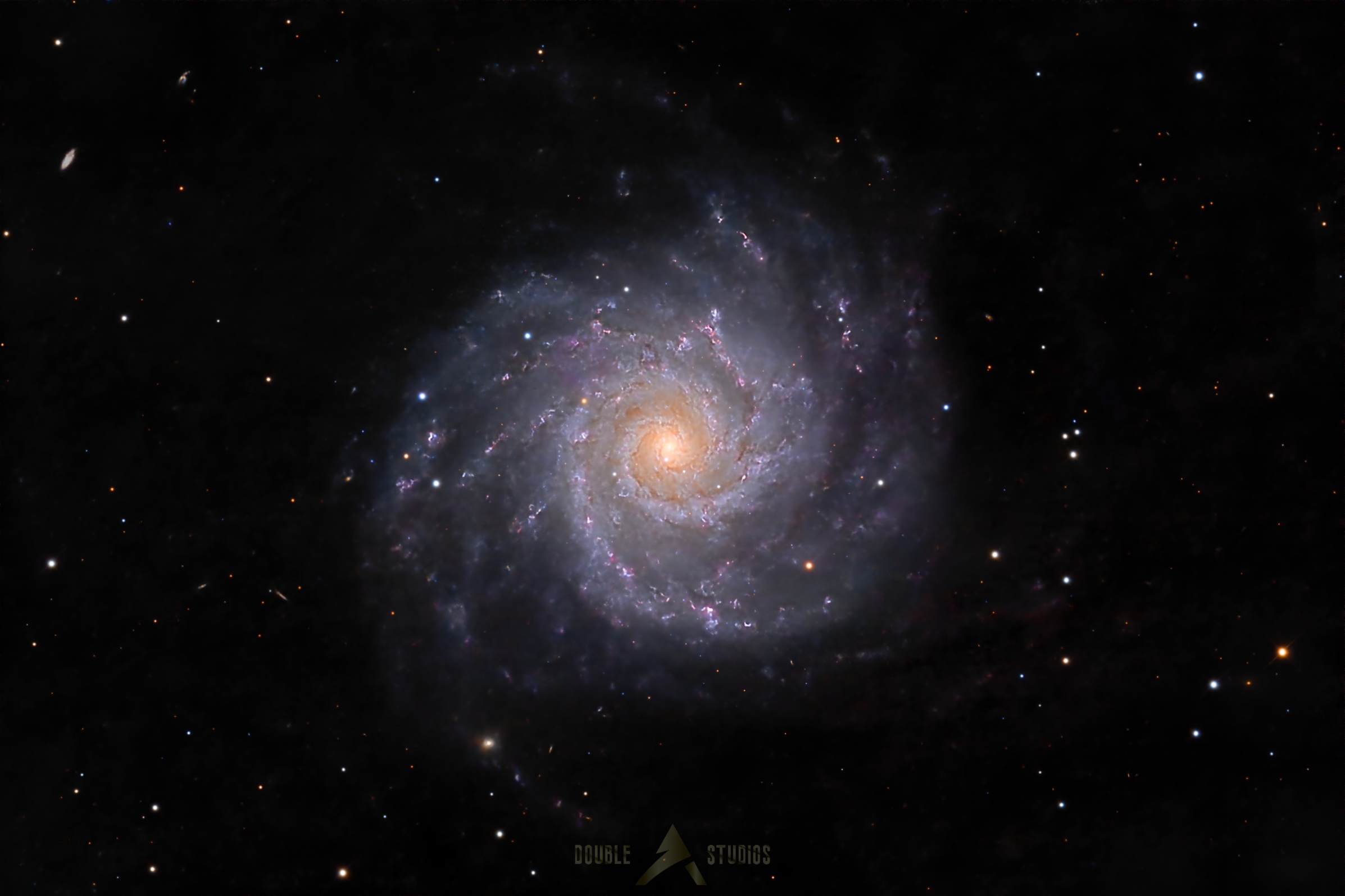
Phantom Galaxy (M74)
Discover the elusive Phantom Galaxy (M74), a stunning spiral 32 million light-years away.
- Object type: Spiral Galaxy
- Designation: M74 / NGC 628
- Hemisphere: Northern
- Constellation: Pisces
- Distance: 32 million light-years
The Elusive Phantom Galaxy — Unveiling M74
Hiding in the distance lies the face-on spiral galaxy M74, an excellent example of a well-defined spiral structure. This faint galaxy belongs to the Sc category within the Hubble sequence, characterized by loosely wound spiral arms that cradle numerous star-forming regions. With a diameter of approximately 95,000 light-years, M74 is slightly smaller than the Milky Way, but it has a more regular, symmetrical structure.
A Stellar Nursery and Star Formation
What makes M74 particularly fascinating is its abundance of H II regions. These are massive clouds of ionized hydrogen gas, which serve as stellar nurseries, where new stars are born. The H II regions in M74 are spread throughout its spiral arms, producing a significant number of young, hot stars. These stars emit intense ultraviolet radiation, which ionizes the surrounding gas, causing it to glow.
In a study led by R. Chandar and J. Gallagher titled “The Star Formation History of the Spiral Galaxy M74” (published in The Astrophysical Journal), they examined M74’s star-forming regions, concluding that “M74 presents significant areas of ongoing star formation, particularly in its spiral arms, similar to what is observed in the Milky Way”. This suggests that the galaxy is actively evolving and may hold clues to understanding how galaxies like our own formed and evolved.
A Black Hole at the Core

The centre of M74 houses a supermassive black hole, estimated to have a mass of about 10 million times that of the Sun. This black hole is surrounded by a dense cluster of stars, and while it is not as active as the black holes in more luminous galaxies like Messier 87, its presence adds to the overall intrigue. Recent observations in the X-ray spectrum by NASA’s Chandra X-ray Observatory revealed an ultra-luminous X-ray source (ULX) near the galaxy's core. It is believed to be either an intermediate-mass black hole or a neutron star accreting material at an unusually high rate.
Supernovae Explosions
Astronomer S. Smartt, in his work “Core-Collapse Supernovae in M74” (published in Astronomy & Astrophysics), observed that “M74 provides a unique environment to study supernovae in a galaxy with ongoing star formation. The supernovae discovered in M74 highlight the lifecycle of massive stars and their role in galactic evolution.”
M74, in fact, has been the site of two significant supernovae in recent history: SN 2002ap and SN 2013ej. Both stellar explosions were classified as Type II supernovae, meaning they were the result of massive stars collapsing at the end of their lives. Supernovae like these contribute to enriching the interstellar medium with heavy elements, which are crucial for forming new stars and planets.
A Challenge for Observers
With an apparent magnitude of 9.4, M74 is notoriously difficult to observe from Earth, particularly with smaller telescopes, which is why it has earned the nickname the Phantom Galaxy. Its surface brightness is relatively low, making it a challenging target, especially under light-polluted skies. However, under dark skies, its spiral arms reveal a stunning level of detail, especially in long-exposure astrophotography.
M74 was discovered by Pierre Méchain in 1780 and later included in Charles Messier's famous catalogue of nebulae and star clusters. Today, M74 continues to be a subject of extensive study, from its black hole to its star-forming regions and supernovae. In fact, researchers are still uncovering new insights into the galaxy’s role in our broader understanding of galactic evolution.
How to Find M74

M74 resides in the Pisces constellation, making it visible primarily in the Northern Hemisphere. To locate it, start by finding the bright star Alrescha (Alpha Piscium), which marks the knot where the two lines of Pisces’ fish intersect. M74 lies about 1.5 degrees east-northeast of this star. While it is not visible to the naked eye, with a moderate-sized telescope (around 6 inches or larger) and under dark skies, you can glimpse its faint glow.
For visual observation, the best time to catch M74 is during the autumn and early winter months, specifically from October to December, when Pisces is high in the night sky. This period provides the best visibility and atmospheric conditions for viewing or photographing the galaxy.
Best Time for Astrophotography
Astrophotographers aiming to capture M74 will find success during the autumn months, particularly around November, when Pisces is high above the horizon and the nights are long. Clear, dark skies far from city lights are essential due to M74’s low surface brightness. Long-exposure photography through larger telescopes can bring out the delicate details of its spiral arms, while filters, such as hydrogen-alpha, can enhance the regions of active star formation within the galaxy.
Equipment
- Mount: Officina Stellare equatorial fork
- Telescope: Officina Stellare ProRC 700
- Camera: QHY 600M
- Filters: Astrodon LRGB
Acquisition details
- Integration: 5 hours 30 min
- Acquisition: Telescope Live
- Processing: PixInsight
- Location: Spain