
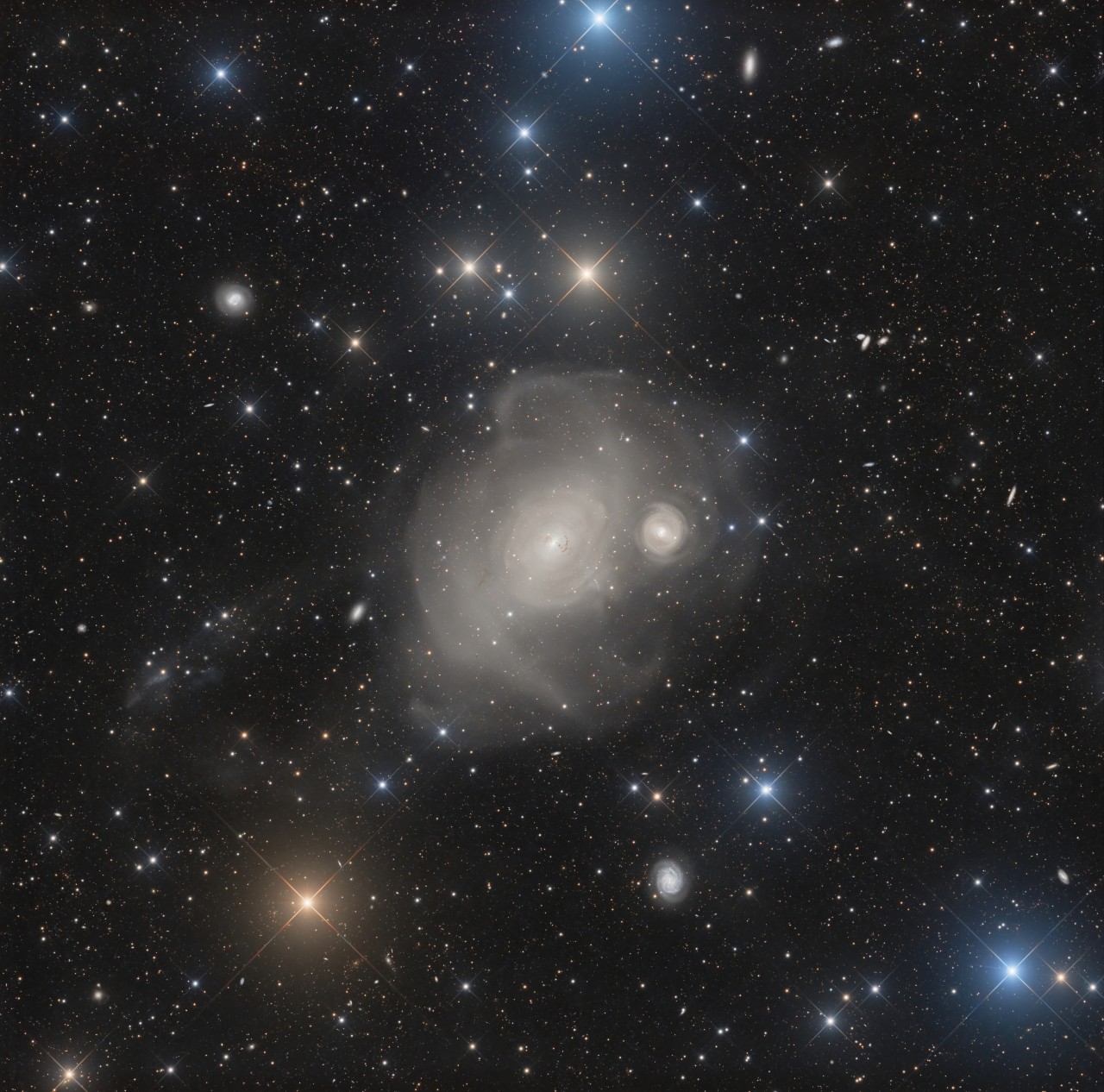
Fornax A (NGC 1316)
For ShaRA #11, the team turned its focus to one of the most intriguing radio galaxies in the Southern Hemisphere: Fornax A (NGC 1316). Read the ShaRA article here.
- Object type: Radio Galaxy, Elliptical Galaxy
- Designation: NGC 1316
- Hemisphere: Southern
- Constellation: Fornax
- Distance: ~62 million light-years
Fornax A: Radio Waves, Mergers, and the Mysteries of an Active Galaxy
Fornax A, also known as NGC 1316, stands out in the southern night sky as one of the most powerful radio galaxies, frequently studied for its intense emission and intriguing history. This galaxy is situated approximately 62 million light-years away in the constellation Fornax, a relatively faint constellation introduced in the 18th century by the French astronomer Nicolas-Louis de Lacaille.
A Merged Past
Fornax A’s unusual morphology has made it an object of intense scrutiny. Deep optical images reveal faint shells, arcs, and loops encircling its central regions—features typically indicative of galactic interactions. In addition, dark dust lanes and ripples criss-cross the galaxy’s bright core, which suggests that the galaxy assimilated a smaller spiral galaxy (or galaxies) in the recent past. Astronomers have combined multiwavelength data—ranging from radio to optical—to piece together a more comprehensive picture of this tumultuous history.
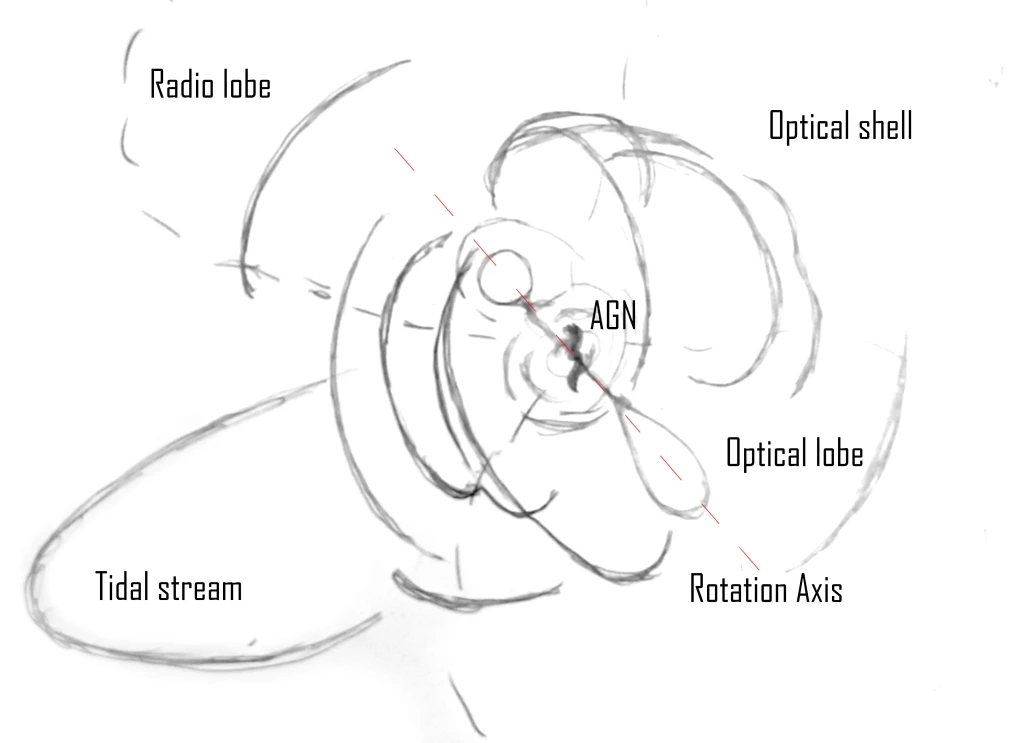
A frequently cited study published in the Astrophysical Journal Letters discusses how “NGC 1316’s strange shape strongly hints at a past collision or merger event” (ApJ Lett. reference). This sort of evolutionary path helps explain why Fornax A exhibits both elliptical-type features and leftover traces more commonly associated with spiral galaxies, such as dust lanes.
As one of the strongest radio sources in the sky, Fornax A owes its “A” designation to its prominence in radio astronomy catalogues. Giant twin lobes of radio emission extend hundreds of thousands of light-years from its core—structures believed to be powered by jets from a supermassive black hole at the galaxy’s centre. Radio lobes are relatively common in massive elliptical galaxies, but the brightness and extent of Fornax A’s jets set it apart as a must-study object in understanding how active galactic nuclei (AGN) shape the galaxies that host them.
A paper in the journal Monthly Notices of the Royal Astronomical Society described Fornax A as "an archetype of a radio-loud merger-remnant galaxy, serving as a vital laboratory for AGN feedback" (MNRAS reference). Observations by facilities such as the Very Large Array (VLA) in New Mexico and the Australian SKA Pathfinder (ASKAP) have helped clarify the morphological details of these jets and how they interact with the intergalactic medium.
Structure and Composition
On closer inspection, Fornax A displays a compact bright centre (typical of a giant elliptical), enveloped in a diffuse halo. Embedded within are the dusty remnants of another galaxy’s spiral arms, providing clear evidence of a relatively recent collision. These dust lanes are best studied through filters in the near-infrared and submillimetre wavebands, revealing molecular gas streams that could fuel future star formation or feed the central black hole.
The star population in Fornax A contains both older, metal-rich stellar populations expected in massive ellipticals, and younger stars that may have been contributed by the ingested galaxy. This hybrid composition underscores the idea that elliptical galaxies are not always quiescent, monolithic structures but can be shaped by continuous interactions throughout cosmic time.
The Active Galactic Nucleus: A Cosmic Powerhouse
At the core of Fornax A lies one of the most powerful AGNs in the nearby universe, powered by a supermassive black hole with an estimated mass of several billion solar masses. This AGN generates relativistic jets that extend nearly a million light-years, carving out vast radio lobes and injecting energy into the surrounding intergalactic medium. Eilek and Arendt (1996) explain, “these jets are not only sculpting the surrounding radio lobes but also injecting heat into the intergalactic medium, impacting the evolution of the galaxy cluster in which Fornax A resides”.
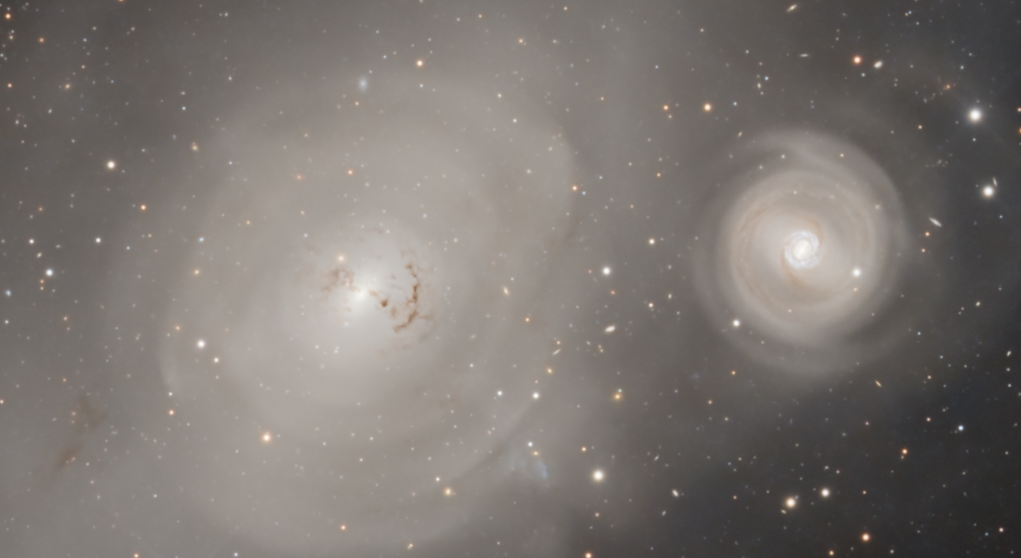
These jets are key to understanding the galaxy's high-energy emissions, as they interact with the interstellar and intergalactic medium, producing shock waves and turbulence that further influence the local environment.
Neutral Hydrogen and Molecular Gas: Traces of the Past
Recent observations with the MeerKAT telescope have identified extensive tails of neutral hydrogen (HI) gas, extending up to 150 kpc from the galaxy. This gas, likely a remnant of that earlier cosmic collision, provides direct evidence of Fornax A’s dynamic history. In addition, molecular gas within the galaxy’s central regions plays a crucial role in ongoing star formation and fuels the AGN, sustaining its energetic output.
Key Neighbours in the Fornax Galaxy Cluster
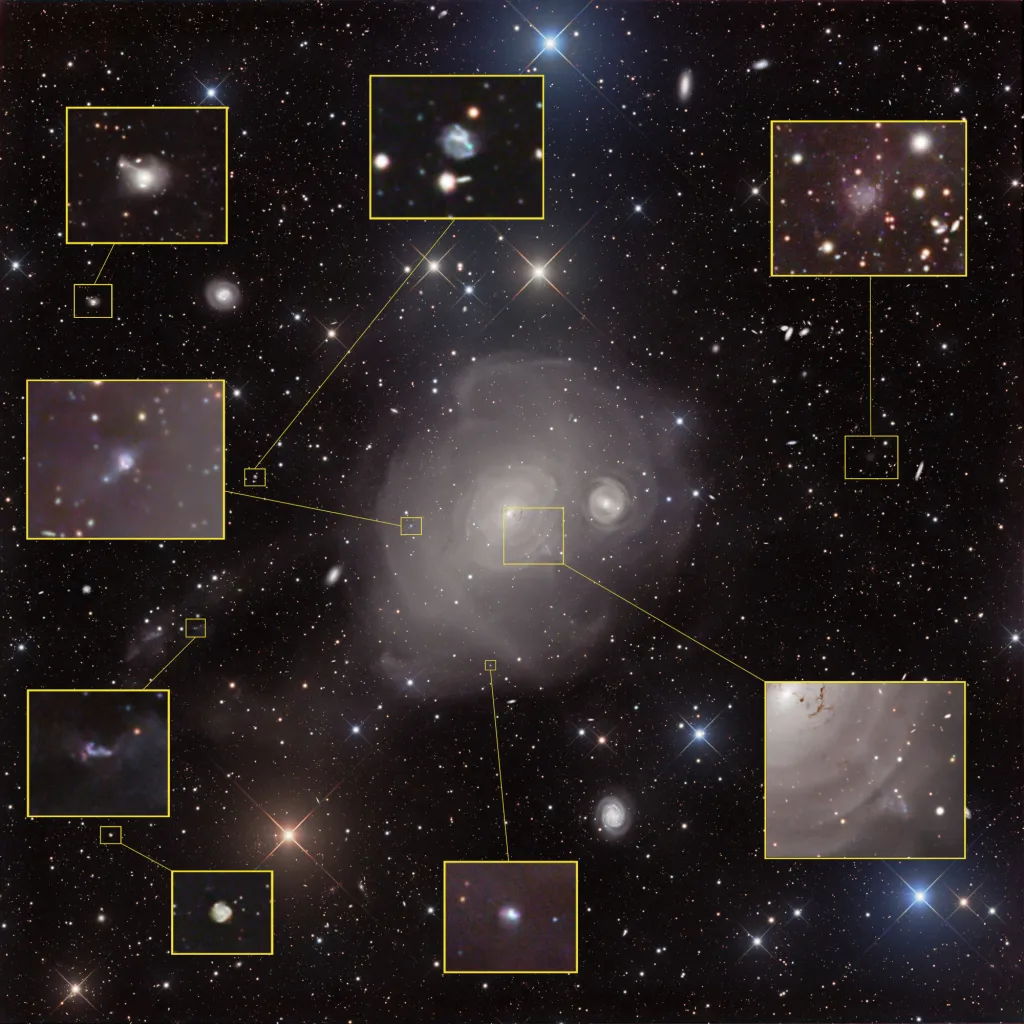
Fornax A is a member of the Fornax Cluster, a collection of galaxies that includes notable members such as NGC 1399 (the cluster’s central elliptical), NGC 1365 (a barred spiral), and several smaller companions. Within the same field of view, keen observers might spot NGC 1317, a nearby galaxy with a more regular structure. NGC 1317 has managed to remain relatively undistorted despite its proximity to the turbulent Fornax A, making for an interesting pair that prompts numerous questions about gravitational influences and the relative mass distributions involved.
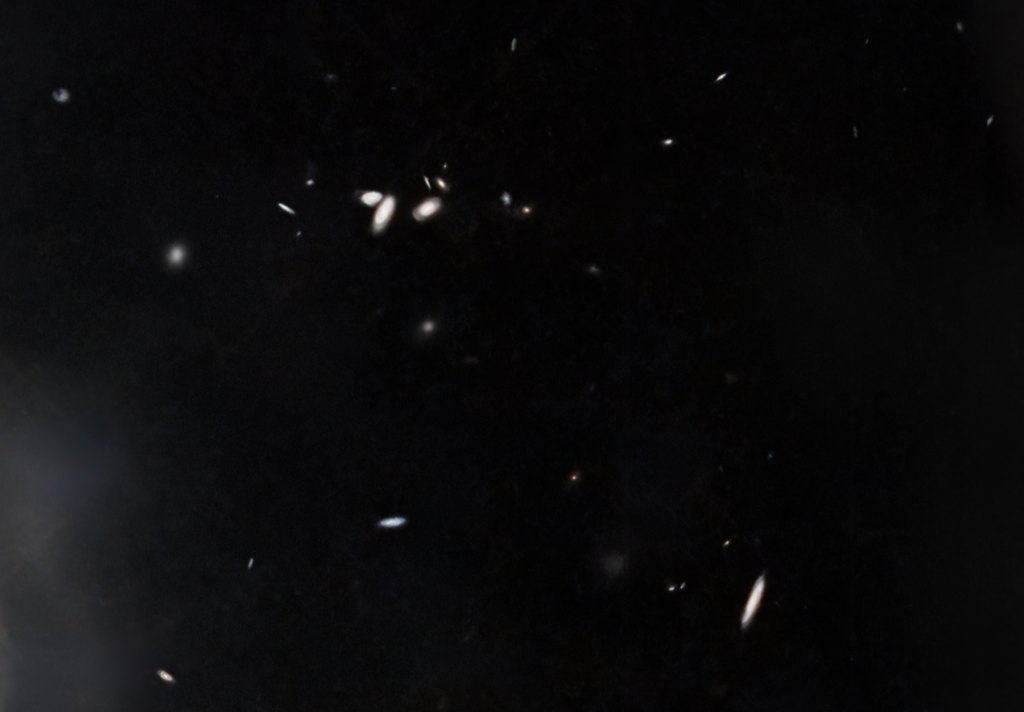
Occasionally, deep imaging also reveals fainter background galaxies sprinkled around the cluster—some are dwarfs orbiting the bigger members, while others are much more distant galaxies appearing as faint smudges.
A Source of Ultra-High-Energy Cosmic Rays
Fornax A’s AGN and relativistic jets have made it a prime candidate for the generation of ultra-high-energy cosmic rays (UHECR). The jets’ interactions with magnetic fields in the galaxy’s radio lobes create conditions capable of accelerating particles to energies exceeding 10^20 eV. Joshi et al. (2018) highlight, “the interaction of relativistic jets with the surrounding medium creates shocks and magnetic turbulence capable of accelerating particles to extreme energies”.
This characteristic positions Fornax A as a critical object for studying the mechanisms behind cosmic ray production and the role of AGNs in high-energy astrophysics.
Scientific Relevance
NGC 1316 serves as a case study in galactic mergers and the subsequent radio loudness that can arise when gas and dust funnel into the supermassive black hole at a galaxy’s core. The energy output from active galactic nuclei can drastically affect star formation, shape the halo, and even drive outflowing winds that enrich the intergalactic medium. Understanding these processes within the galaxy sheds light on the broader question of how galaxies co-evolve with their central black holes.
Radio astronomers find Fornax A particularly appealing because the visible arcs and shells line up with the radial structures in the radio lobes, indicating a direct connection between the galaxy’s past mergers and its active nucleus. As new instruments such as the Square Kilometre Array (SKA) in Australia and South Africa become operational, they promise to deliver higher resolution images of Fornax A’s complex radio morphology. This might help resolve unsolved questions about the timing and dynamics of the merger events, as well as the precise mechanisms driving such immense radio luminosity.
Researchers also pay close attention to the metallicities and ages of stars around the dust lanes in Fornax A, comparing them to model predictions of galaxy mergers. This line of study can distinguish whether the spiral galaxy that Fornax A absorbed was similar to the Milky Way or smaller and less evolved. Each new piece of the puzzle helps refine theoretical models of galaxy formation and highlights the importance of collisions in shaping cosmic structures.
A Target for Astrophotographers
From a purely observational standpoint in the Southern Hemisphere, November through January often provide the best chance to view Fornax A well above the horizon at a convenient observing time. Early morning or late evening sessions (depending on the season) offer the darkest skies with minimal interference from the Moon’s phases. Professional observatories schedule radio and optical studies of Fornax A in synergy, often focusing campaigns when Earth’s orbital geometry enables multi-wavelength data sets to be captured efficiently.
Although Fornax itself is not a particularly large or bright constellation, star-hopping from brighter neighbouring constellations like Eridanus or Cetus may help locate the region. Binoculars will not reveal much more than a dim blur, but a moderate to large amateur telescope under dark skies might show the galaxy’s bright core. Its diffuse halo and patchy dust lanes, however, are challenging even for experienced observers due to the faintness of these features.
References:
- Goudfrooij, P., et al. (2001). “Kinematics, ages and metallicities of star clusters in NGC 1316: a 3-Gyr-old merger remnant.” Monthly Notices of the Royal Astronomical Society, 322(3), 643–657.
- Joshi, S.R., et al. (2018). “Ultra-High-Energy Cosmic Rays and Active Galactic Nuclei.” Monthly Notices of the Royal Astronomical Society.
- Eilek, J.A., & Arendt, P.N. (1996). “Radio Galaxies and Their Role in Galaxy Clusters.” Astrophysical Journal Letters.
- Serra, P., et al. (2019). “Neutral hydrogen gas within and around NGC 1316.” arXiv preprint arXiv:1907.08265.
- Richtler, T., et al. (2008). “The supermassive black hole of Fornax A*.” Monthly Notices of the Royal Astronomical Society, 391(4), 1629–1638.
Equipment
- Mount: ASA DDM85
- Telescope: ASA Newtonian 500mm @ F/3,8
- Camera: FLI ProLine PL16803 CCD
- Filters: Astrodon LRGB
Acquisition details
- Integration: 31 hours 10 min
- Acquisition: Chilescope
- Processing: PixInsight
- Location: Chile