
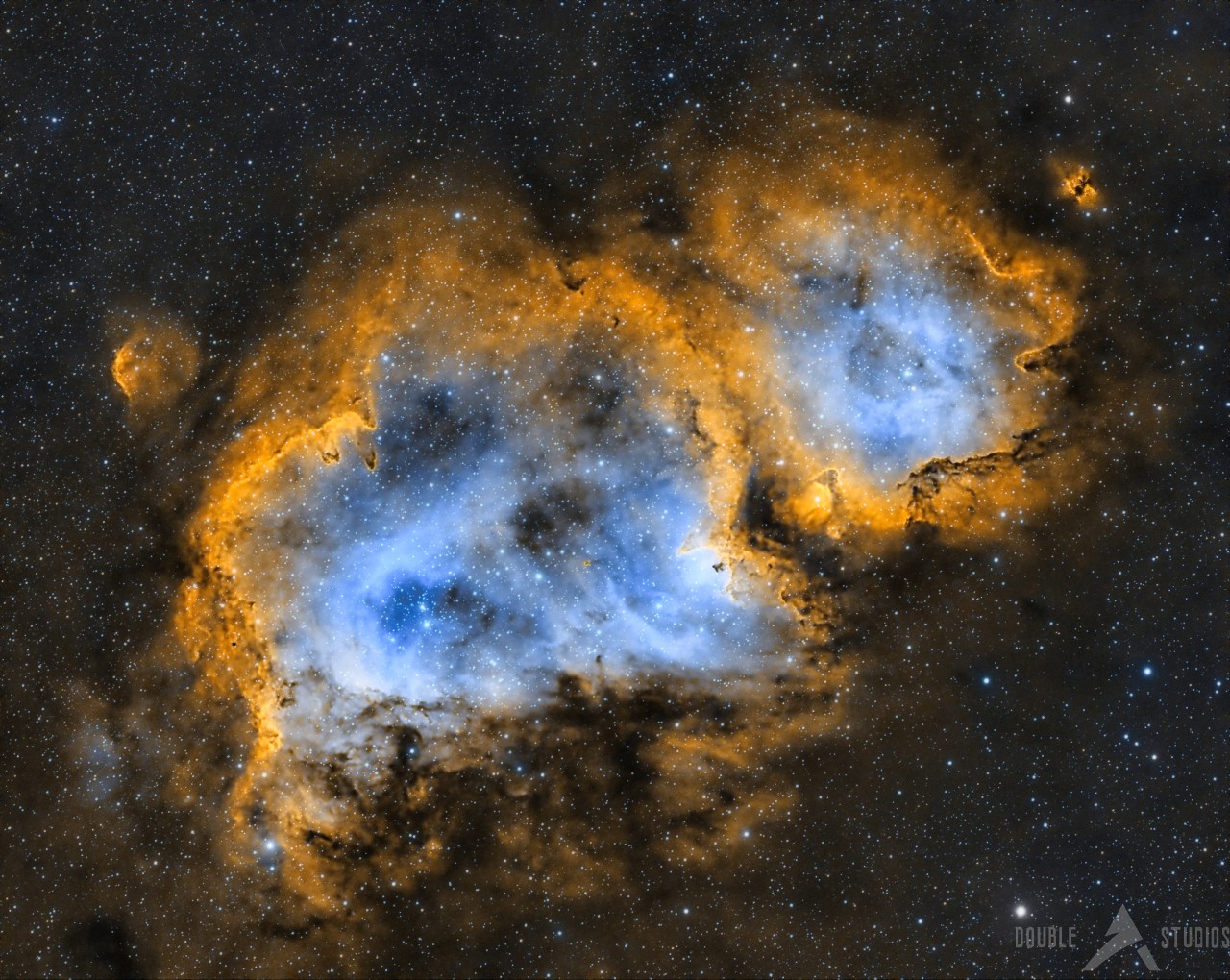
Soul Nebula (IC 1848)
Observation Summary
27-30 September 2023
91.3% - 96.4%
02h 51m 00s / +60° 24′ 00″
∼6.5
∼150′ × 150′
Summary
Emission Nebula
IC 1848, Sh2-199
Northern
Cassiopeia
∼7,500 light-years
Technical Details
ZWO AM5
RedCat 51
ZWO ASI294MC-Pro
Optolong L-Ultimate 3 nm
WO UniGuide 32
ZWO ASI220MM Mini
ZWO ASIAIR Plus
14 h
PixInsight
Luxembourg
Soul Nebula (IC 1848): massive star formation in the Perseus Arm
The Soul Nebula, catalogued as IC 1848, is a vast emission nebula and active star-forming complex located in the constellation Cassiopeia, within the Perseus spiral arm of the Milky Way. Together with its neighbouring structure, the Heart Nebula (IC 1805), it forms one of the most prominent large-scale star-forming regions visible from the northern hemisphere.
IC 1848 spans roughly 2° on the sky, corresponding to a physical size of approximately 160–200 light-years, and lies at a distance of about 2.0–2.5 kpc. It is frequently identified with the radio source Westerhout 5 (W5), which represents the ionised gas component of the nebula detected at centimetre wavelengths. Like IC 1805, the Soul Nebula is not a single homogeneous cloud, but a structured complex of ionised gas, dense molecular material, dust lanes, and young stellar populations at different evolutionary stages.
Early observations
The nebulosity now known as IC 1848 was first noted visually in the late 18th century by William Herschel, during his systematic survey of faint nebulae in the northern sky. At the time, such objects were classified purely by appearance, and their physical nature remained uncertain.
The designation IC 1848 was later assigned in the Index Catalogue, compiled in the late 19th century as a supplement to Dreyer’s New General Catalogue. Its true nature as an H II region became clear only in the 20th century, with the development of astrophotography, spectroscopy, and radio astronomy. Radio surveys in particular established W5 as a major ionised region powered by massive stars embedded within IC 1848.
Structure and composition
The Soul Nebula exhibits a complex morphology shaped by stellar feedback on multiple scales. Optical and infrared images reveal large cavities filled with ionised gas, bordered by bright emission rims and interwoven with dark dust lanes. These structures are the result of expanding ionisation fronts and stellar winds interacting with the surrounding molecular clouds.
Several elongated pillars and cometary globules are visible along the nebula’s edges, pointing toward the dominant ionising sources. These features are interpreted as dense remnants of the original molecular cloud that are being eroded by ultraviolet radiation, while potentially harbouring ongoing or future star formation within their cores.
At larger scales, IC 1848 is dynamically linked to the Heart Nebula through the broader W3–W4–W5 complex, suggesting a history of sequential star formation propagating through the Perseus Arm over several tens of millions of years.
IC 1848 is primarily composed of ionised hydrogen, producing strong H-alpha emission. Emission lines from ionised sulphur ([S II]) and oxygen ([O III]) trace variations in density, temperature, and excitation across the nebula. Compared with IC 1805, the Soul Nebula generally shows a higher degree of structural fragmentation, reflecting the interaction of ionising sources with a more heterogeneous molecular environment.
Embedded molecular clouds, traced through CO and other molecular lines at radio wavelengths, represent the cold component of the nebula. These clouds are the sites of current and future star formation and are partially shielded from ionising radiation by dust. Infrared observations show widespread thermal emission from dust grains heated by nearby massive stars.
Stellar population
The nebula hosts several young stellar clusters and associations, dominated by O- and early B-type stars responsible for ionising the surrounding gas. These stars have typical ages of a few million years, indicating that IC 1848 is a relatively young region on Galactic timescales.
In addition to these massive stars, deep infrared and X-ray surveys have identified large populations of pre-main-sequence stars, including classical and weak-lined T Tauri stars. This confirms that star formation in IC 1848 occurs across a wide mass spectrum and is still ongoing in parts of the nebula.
The spatial distribution of stellar ages suggests that star formation has proceeded in a triggered or propagating manner, likely initiated by earlier generations of massive stars whose feedback compressed neighbouring molecular material.
Relationship to the Heart Nebula and triggered star formation
IC 1848 and IC 1805 are frequently analysed as a coupled system because of their close spatial proximity, comparable distances, and shared location within the Perseus spiral arm. Together, they form part of the larger W3–W4–W5 star-forming complex, one of the most extensively studied examples of large-scale, feedback-driven star formation in the Milky Way.
The prevailing evolutionary framework interprets both nebulae as products of sequential star formation, initiated by earlier generations of massive stars in the W4 region. In this scenario, stellar winds and ionising radiation from an older OB association created a large, expanding superbubble.
As this bubble expanded, it swept up surrounding interstellar material into dense shells at its periphery. Gravitational instabilities within these compressed shells subsequently led to the formation of new massive stars, giving rise to regions such as IC 1805 and IC 1848.
Observational evidence strongly supports this model. Radio and infrared studies reveal coherent large-scale velocity structures consistent with expanding shells, while molecular line observations show enhanced gas densities at the interfaces between ionised and neutral material. The spatial alignment of IC 1805 and IC 1848 along the edges of the W4 superbubble is difficult to reconcile with spontaneous, isolated cloud collapse and instead points toward externally driven compression as the dominant triggering mechanism.
The Heart–Soul complex illustrates how massive-star feedback operates on scales of hundreds of light-years, shaping not only individual nebulae but entire star-forming corridors within spiral arms. Rather than simply suppressing star formation by dispersing gas, feedback in this environment appears to have played a dual role: clearing central cavities while simultaneously promoting new star formation at their peripheries.
This makes IC 1848 and IC 1805 a benchmark system for testing theoretical models of feedback-regulated star formation. Their relative proximity, favourable orientation, and rich multi-wavelength data sets allow detailed comparison between observations and simulations, offering key insights into how successive generations of stars arise within the structured interstellar medium of spiral galaxies.
Recent studies
In the past five years, IC 1848 has been the subject of renewed interest due to advances in multi-wavelength observational capabilities:
Infrared surveys combining space-based and ground-based data have refined the census of young stellar objects, allowing more accurate age estimates and spatial correlations with gas structures.
High-resolution spectroscopy has mapped gas velocities across the nebula, revealing expanding shells and signs of turbulence induced by stellar winds.
Polarimetric observations have begun to constrain the role of magnetic fields in shaping filaments and pillars, indicating that magnetic pressure contributes to stabilising some dense structures against rapid dispersal.
Numerical simulations, informed by these observations, have been used to model the long-term evolution of the W5 region, supporting a scenario in which feedback both suppresses and enhances star formation depending on local conditions.
These studies reinforce IC 1848’s role as a key laboratory for understanding how massive stars regulate star formation on large spatial scales.
Future evolution
Over the next few million years, the most massive stars in IC 1848 will evolve off the main sequence and explode as core-collapse supernovae. These events will inject substantial energy and heavy elements into the surrounding interstellar medium, further disrupting the remaining molecular clouds.
As the gas is dispersed, star formation will gradually decline, and the stellar clusters will begin to dissolve. On longer timescales, the stars born in IC 1848 will become part of the general stellar population of the Perseus Arm, while the nebula itself will fade from view.
Observing IC 1848
IC 1848 is located in Cassiopeia, near the border with Perseus. From mid-northern latitudes, it is circumpolar and can be observed throughout the year, though its altitude and orientation vary seasonally.
The nebula lies close to the line connecting Gamma Cassiopeiae and the Perseus Double Cluster, making it accessible with wide-field star charts or planetarium software. Its large angular size means that it is best approached as a wide-field target rather than a compact object.
The best time for observing the Soul Nebula is from late summer to winter (approximately August to February), when Cassiopeia is prominent in the evening sky. Due to its low surface brightness, it is extremely difficult due observe visually but large apertures and narrowband filters may reveal faint nebulosity under very dark skies.
References (selected)
– Herschel, W. (1787), Philosophical Transactions of the Royal Society
– Karr, J. L. & Martin, P. G. (2003), ApJ, studies of W5
– Koenig, X. P. et al. (2008), ApJ, triggered star formation in W5
– Rivera-Ingraham, A. et al. (2011), ApJ, Herschel view of IC 1848
– Recent multi-wavelength and simulation studies (2019–2024), ApJ, A&A, MNRAS