
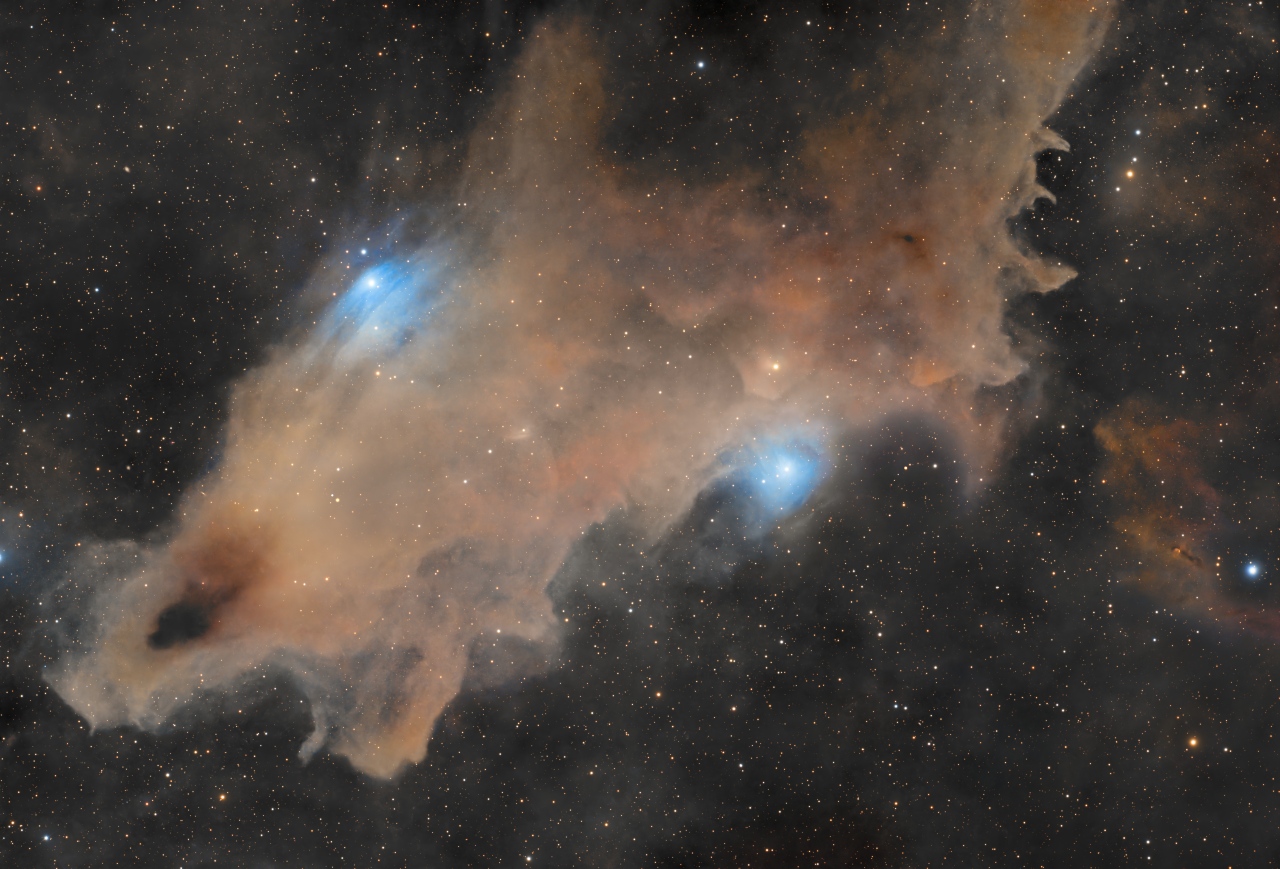
Shark Nebula (LDN 1235)
Observation Summary
25-28 August 2024
55.1% -> 24.1%
20h 56m 00s / +68° 00′ 00″
Not applicable (dark nebula; very low surface brightness)
∼120′ × 30′
Summary
Dark nebula
LDN 1235
Northern
Cepheus
∼1,100 light-years
Technical Details
ZWO AM5
Askar 107PHQ
ZWO ASI294MC-Pro
Optolong L-Pro
Askar OAG
ZWO ASI220MM-Mini
ZWO ASIAIR Plus
320 × 180 s
16 h
PixInsight
Luxembourg
Galactic Predator, the Mysterious Shark Nebula (LDN 1235)
In the far reaches of the Cepheus constellation drifts a striking cosmic formation with a silhouette both familiar and ominous: the Shark Nebula. Officially designated as LDN 1235, this dark nebula earned its nickname thanks to its unmistakable resemblance to a shark gliding through deep interstellar waters.
Discovery and First Observations
The story of LDN 1235 begins in 1962, when American astronomer Beverly T. Lynds included it in her landmark Catalogue of Dark Nebulae, based on photographic plates from the Palomar Observatory Sky Survey. The surrounding, slightly brighter regions were later designated as LBN 535 in her Catalogue of Bright Nebulae, published in 1965. In 1966, astronomer Sidney van den Bergh added more detail to this region by identifying two embedded reflection nebulae, vdB 149 and vdB 150, each lit by nearby B8-type stars. These luminous stars gently illuminate the surrounding dust, revealing otherwise hidden tendrils of interstellar matter.
Main Characteristics
Located at a distance of approximately 1,075 to 1,205 light-years from Earth, according to SIMBAD data, the Shark Nebula spans about 15 light-years across. Despite its size, it is exceptionally faint, imperceptible to the naked eye and even a challenge for telescopes under average skies. It is composed of cold interstellar gas and dust, dense enough to block background starlight and appear as a dark silhouette against the Milky Way.
Embedded within this complex are not only patches of glowing gas and faint stars, but also areas exhibiting extended red emission (ERE), a rare photoluminescent glow produced when dust grains are energized by high-energy photons. This phenomenon provides crucial clues about the physical and chemical properties of interstellar dust grains and the energy environment of the nebula.
Star Population
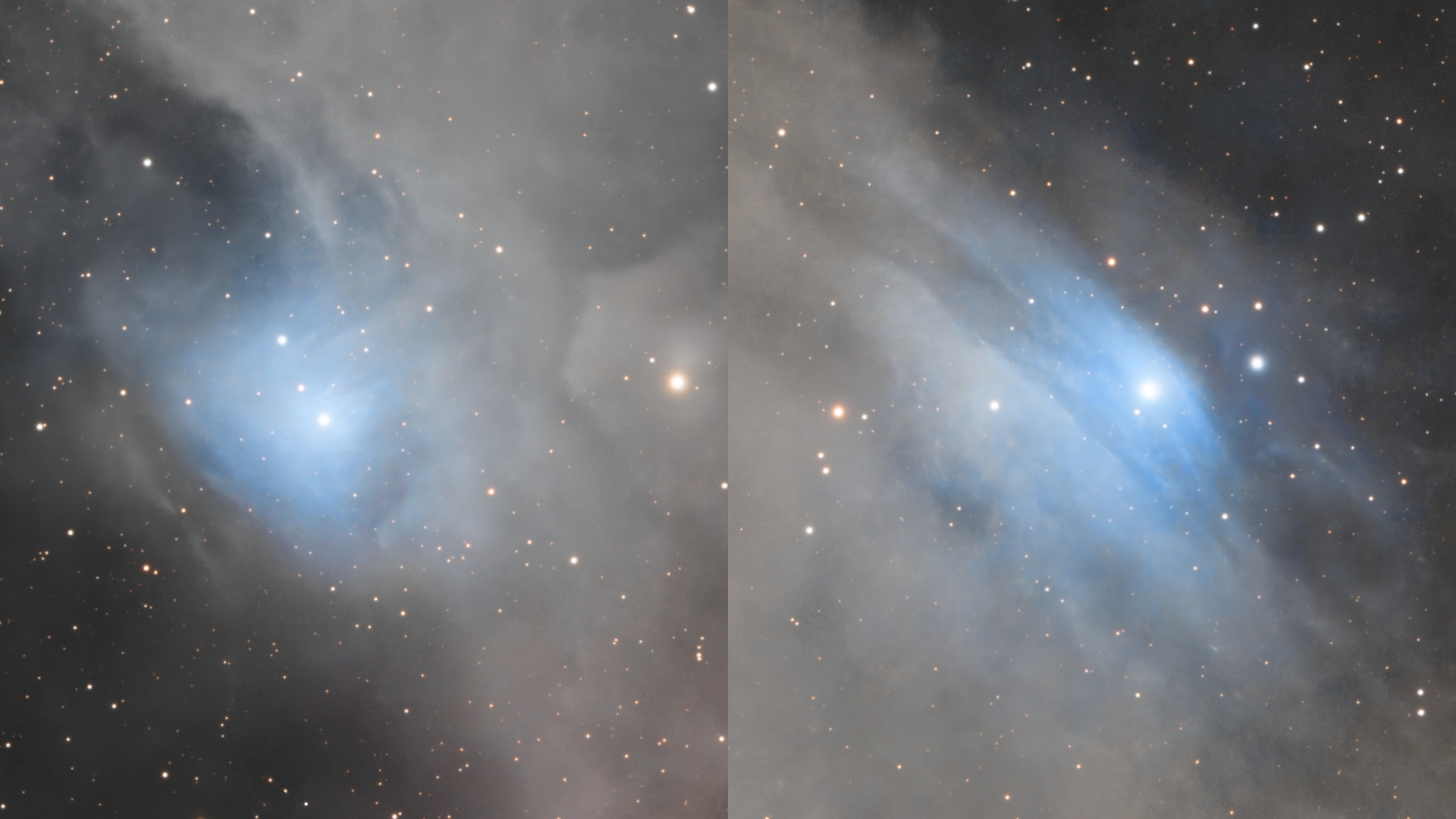
Structurally, LDN 1235 is embedded within a larger molecular cloud complex, a region where stars are forming. The nebula's dense core has evolved into an active star-forming region, with an estimated age of one to five million years. Here, gravitational collapse gradually ignites gas and dust, fuelling the formation of young, intermediate-mass stars.
Among the stellar population, young, intermediate-mass stars are beginning to emerge, typical of early-phase stellar nurseries. Two such stars—BD+72 1018 and BD+72 1020, both classified as B8-type stars—play a prominent role in the nebula’s appearance. Their light reflects off nearby dust, creating the subtle glow of the reflection nebulae vdB 149 and vdB 150, which are located near the edges of LDN 1235 and provide clear evidence of the interaction between starlight and surrounding interstellar dust.
Scientific Relevance
LDN 1235's scientific significance lies in its capacity to illuminate the earliest stages of star formation and the behaviour of the interstellar medium. Because of its high dust content and proximity to young stars, it acts as a natural laboratory for studying the interaction between stellar radiation and interstellar dust. Researchers interested in ERE, in particular, find in LDN 1235 a rich testing ground for understanding how and why certain particles emit light under specific conditions, an effect still not entirely understood.
Observing LDN 1235
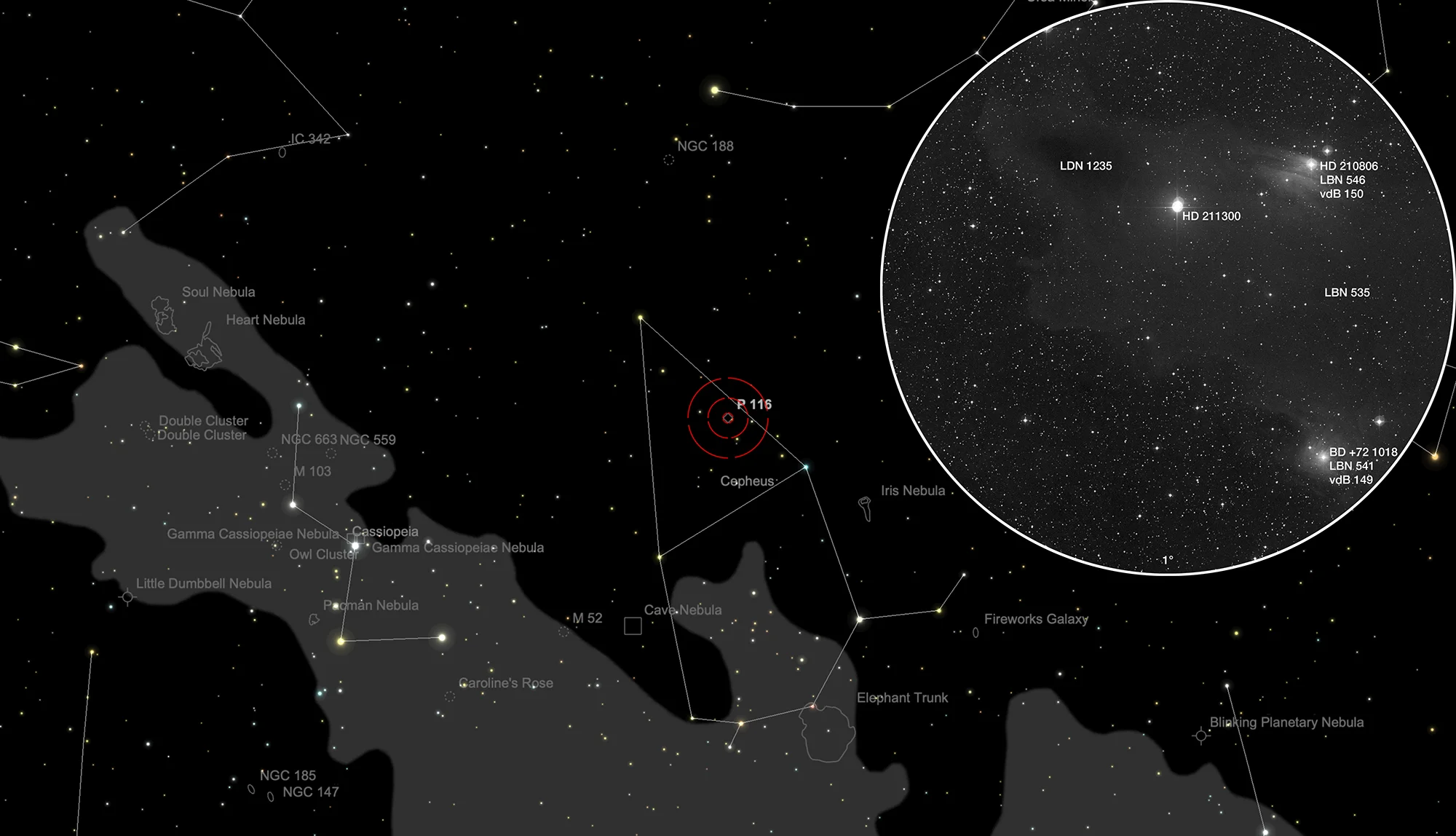
LDN 1235 is best observed from the Northern Hemisphere, particularly between May and December, when Cepheus rides high in the night sky. To locate it, observers can begin at the bright stars Alderamin (Alpha Cephei) and Alfirk (Beta Cephei), gradually sweeping toward the northeast edge of the constellation. Observationally, the nebula remains a challenging target due to its very low surface brightness. Imaging on the other hand requires long exposure times and meticulous post-processing to bring out its subtle details.
References
- Lynds, B. T. (1962). Catalogue of Dark Nebulae. Astrophysical Journal Supplement.
- Lynds, B. T. (1965). Catalogue of Bright Nebulae. Astrophysical Journal Supplement.
- van den Bergh, S. (1966). A Study of Reflection Nebulae. Publications of the David Dunlap Observatory.
- SIMBAD Astronomical Database. LDN 1235 – Object Information. Centre de Données astronomiques de Strasbourg.