
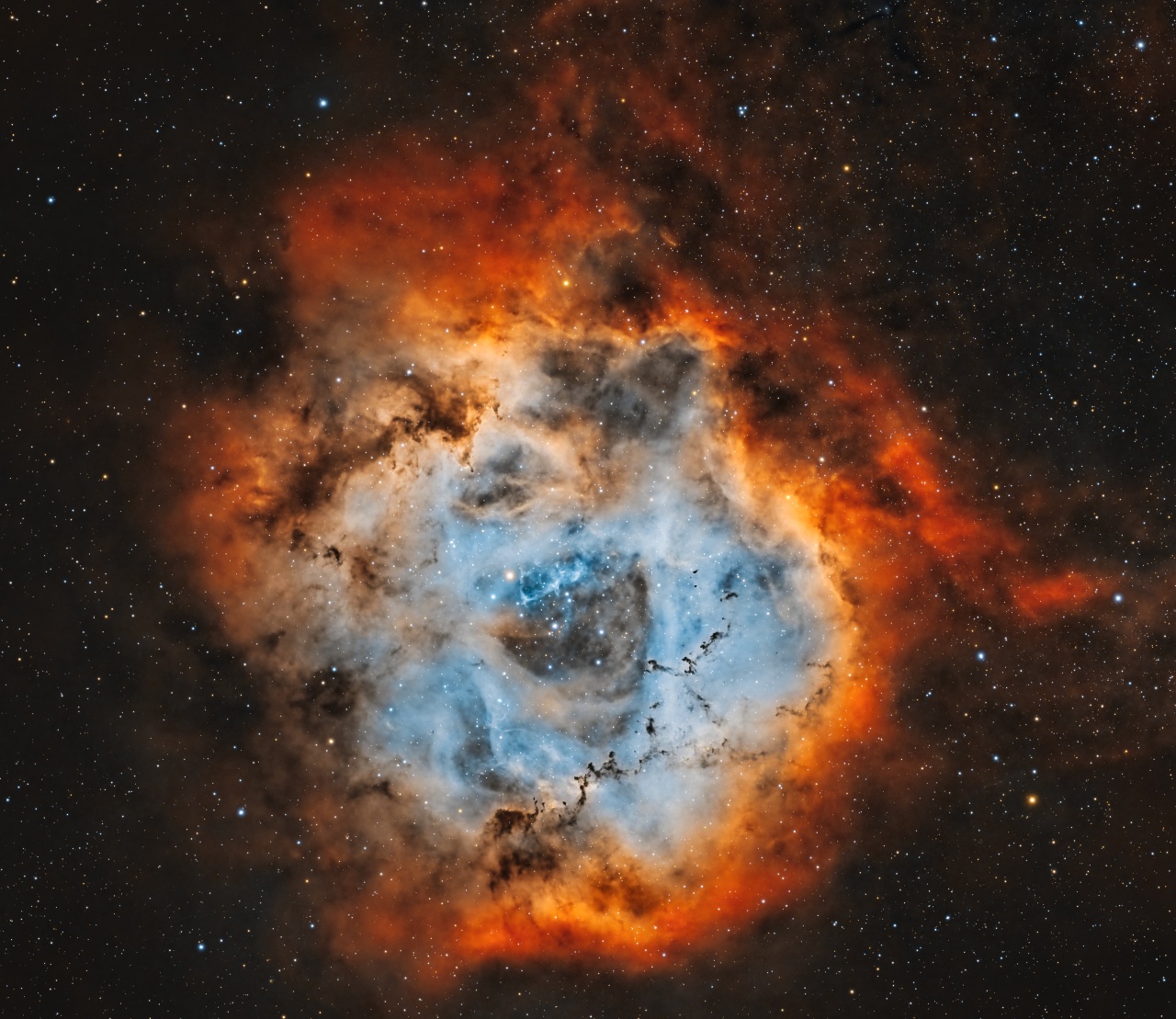
Rosette Nebula (NGC 2237)
Observation Summary
09 Oct 2022 | 07 Feb 2023
98% | 34%
06h 31m 55s / +04° 56′ 34″
∼9.0 (integrated; very low surface brightness)
∼80′ × 60′
Summary
Emission nebula
NGC 2237 (Rosette Nebula)
Northern
Monoceros
∼5,200 light-years
Technical Details
ZWO AM5
RedCat 51
ZWO ASI294MC-Pro
Optolong L-Ultimate
Askar OAG
ZWO ASI220MM-Mini
ZWO ASIAIR Plus
211 × 300 s
17 h
PixInsight
Luxembourg – Brazil
This project marks the first collaboration between Double A Studios and the Federal University of Technology – Paraná (Brazil), which joined forces to produce a stunning image of the Rosette Nebula (NGC 2237).
Over the course of several nights, Professor Dr. Thiago Gilberto Do Prado and I collected more than 17 hours of data on this iconic nebula, using similar equipment that produced data with the same pixel scale.
NGC 2237: A Scientific Overview of the Rosette Nebula
Colloquially known as the Rosette Nebula, NGC 2237 is a well-studied H II region located in the Monoceros constellation, approximately 5,200 light-years from Earth. This region has been the subject of astronomical interest for centuries. Its central open cluster, NGC 2244, was first documented by John Flamsteed in 1690, with later observations by William Herschel in the late 18th century expanding our understanding. Over time, the nebulous regions—including NGC 2237—were catalogued, contributing to a more comprehensive mapping of this celestial marvel.
Structure
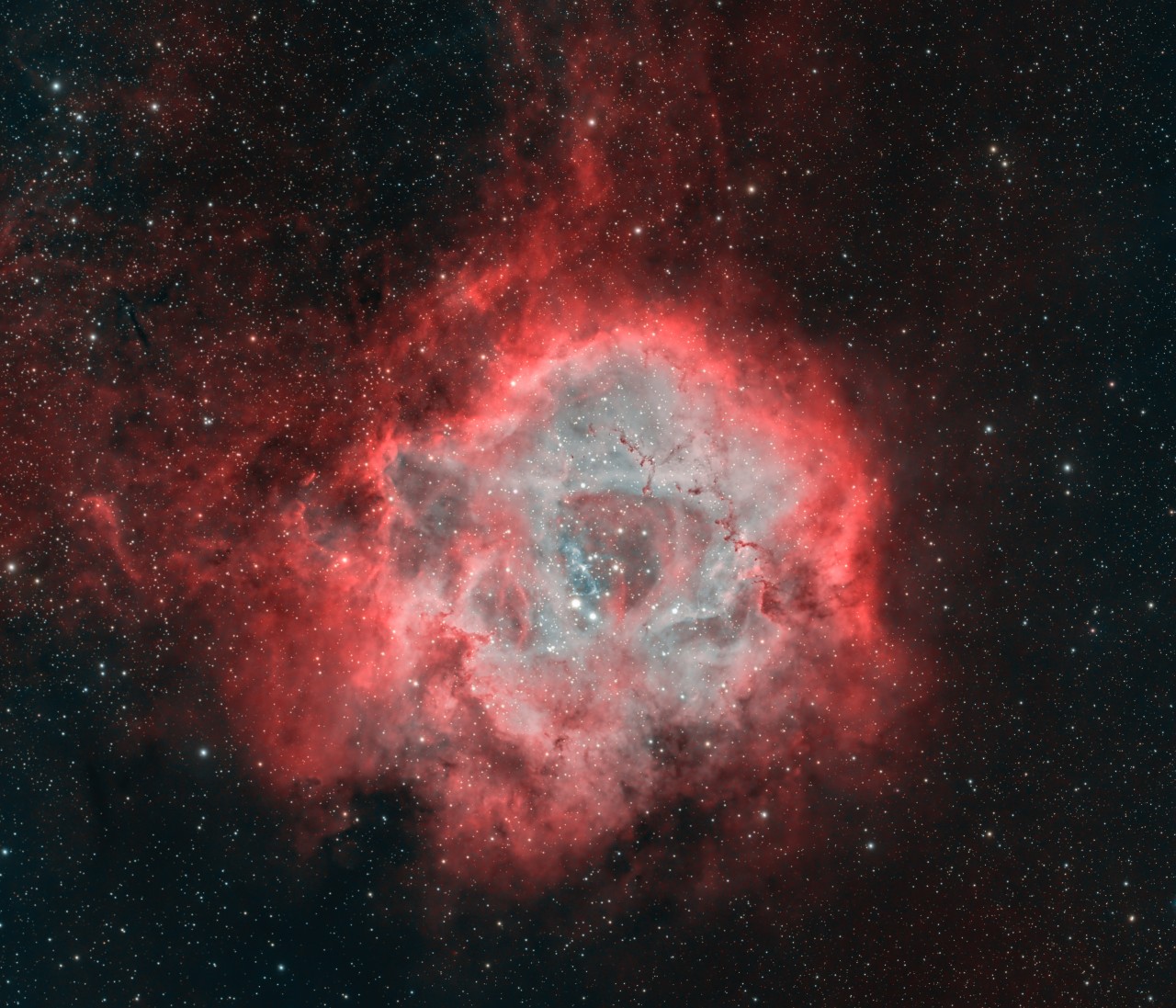
The Rosette Nebula is a vast region of ionized hydrogen gas, shaped primarily by the central star cluster, NGC 2244. The intense ultraviolet radiation from its young, massive O-type stars, such as HD 46223 and HD 46150, ionizes the surrounding gas, making it glow in visible light. With an estimated mass of about 10,000 solar masses, the nebula consists mainly of hydrogen and helium, along with trace elements like oxygen, carbon, and nitrogen.
Spanning approximately 130 light-years in diameter, the Rosette Nebula is a prominent region of star formation. Several distinct components contribute to its overall mass and complexity, including NGC 2237, which plays a crucial role in shaping the nebula’s structure. The surrounding dense clouds of gas and dust, illuminated by the cluster’s young stars, create intricate glowing filaments, adding to the nebula’s striking contrast.
Central Cavity
The nebula’s striking, rose-like appearance results from the powerful radiation and stellar winds from NGC 2244, which have sculpted a central low-density cavity. These winds have cleared out the gas and dust in the centre, forming a roughly circular void surrounded by a shell of ionized material.
Interestingly, the observed cavity size does not fully align with theoretical predictions. Dr. Christopher Wareing and his team proposed that the nebula likely formed in a thin, sheet-like molecular cloud, which may explain why the cavity appears smaller than expected. “To have a model that so accurately reproduces the physical appearance in line with the observational data, without setting out to do this, is rather extraordinary”, Wareing noted (Wareing et al., 2018).
Shell and Pillars
The nebula’s outer shell consists of ionized gas and dust, continuously sculpted by radiation and stellar winds. Within this shell, pillar-like structures remain intact—dense regions of gas that resist erosion.
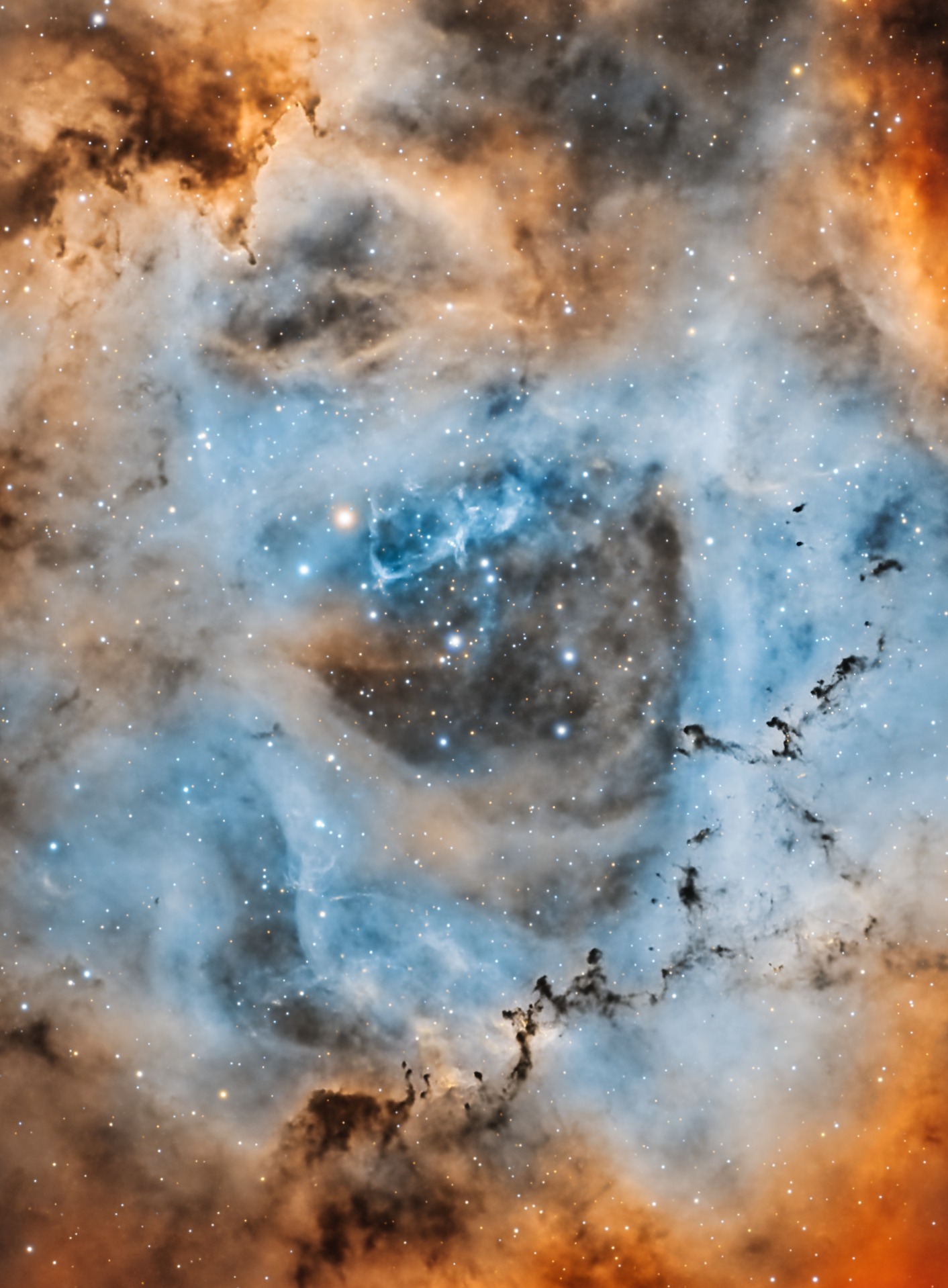
These formations are active star-forming sites, where gas compression can trigger gravitational collapse, leading to the birth of new stars. A study by Mäkelä et al. (2017) confirmed ongoing star formation in these structures, noting that “most of the active star formation in Rosette is taking place in the clusters rather than widespread triggered formation”.
Composition and Star Population
NGC 2237 and the broader Rosette Nebula host thousands of young stars, including several massive O-type stars responsible for ionizing the surrounding gas and producing the nebula’s characteristic red glow. The central cluster, NGC 2244, consists of young, massive stars that have recently emerged from the nebula’s material. Their stellar winds and radiation continuously shape the surrounding gas and dust, sculpting intricate structures within the nebula.
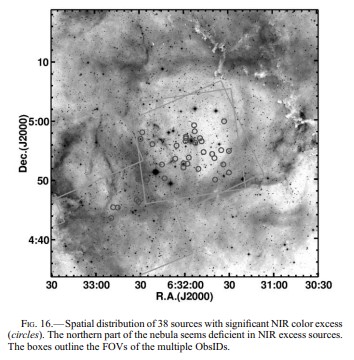
With thousands of young stellar objects (YSOs) at various developmental stages, the Rosette Nebula is an active star-forming region. Infrared and radio observations have detected protostars and substellar objects, offering valuable insights into the initial mass function (IMF) and the early stages of star formation.
A detailed study by Mužić et al. (2022) identified nearly 3,000 probable stellar members within the nebula. The stars in NGC 2244 have an estimated mean age of about 2 million years. Observations suggest that NGC 2244 is expanding outward, indicating it may be an unbound system. “The cluster’s expansion velocity increases with radius, implying a super-virial formation scenario”, the study concluded.
Kinematics and Dynamics
The nebula’s internal motion is highly complex, influenced by stellar winds, radiation pressure, and gravitational interactions. Data from the Gaia mission and high-resolution spectroscopic studies reveal that NGC 2244 exhibits both radial expansion and rotation, signaling a formation process involving hierarchical assembly or monolithic collapse. Additionally, surrounding stellar groups exhibit distinct kinematic behaviours, indicating multiple formation events within the same region (Lim et al., 2021).
High-Energy Emissions
The Rosette Nebula is a known source of diffuse gamma-ray emission. Recent analyses using data from the Fermi Large Area Telescope (LAT) indicate that its gamma-ray spectrum is harder than previously reported. This may indicate that the nebula functions as a high-energy particle accelerator, similar to other young massive star clusters. “The hard spectrum suggests an efficient cosmic-ray acceleration process associated with the stellar winds of NGC 2244”, reported Liu et al. in their 2023 study (Liu et al., 2023).
Observing the Rosette Nebula
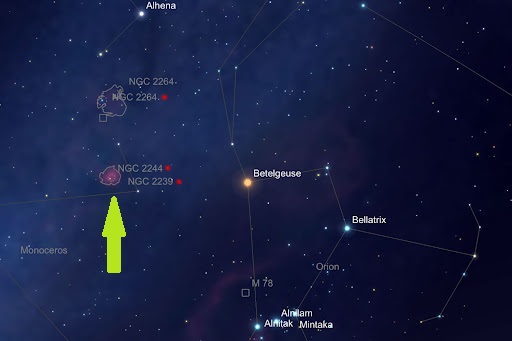
Located in the constellation Monoceros, the Rosette Nebula is best observed during the winter months in the Northern Hemisphere. To locate it, find the bright stars Betelgeuse in Orion and Procyon in Canis Minor; the nebula lies roughly midway between them. Under dark skies, the central cluster, NGC 2244, can be glimpsed with binoculars, while the surrounding nebulosity requires a telescope and may benefit from the use of nebula filters to enhance contrast.
References
- Menon, T. K. (1962). A Study of the Rosette Nebula NGC 2237-46. The Astrophysical Journal.
- Mäkelä, M. M., et al. (2017). *Star Formation in the Rosette Nebula.* Astronomy & Astrophysics.
- Mužić, K., et al. (2022). *Stellar Population of the Rosette Nebula and NGC 2244.* Astronomy & Astrophysics.
- Wareing, C. J., et al. (2018). *A New Mechanical Stellar Wind Feedback Model for the Rosette Nebula.* Monthly Notices of the Royal Astronomical Society.
- Lim, B., et al. (2021). *A Kinematic Perspective on the Formation Process of the Stellar Groups in the Rosette Nebula.
- Liu, J., et al. (2023). *Diffuse Gamma-Ray Emission Around the Rosette Nebula.