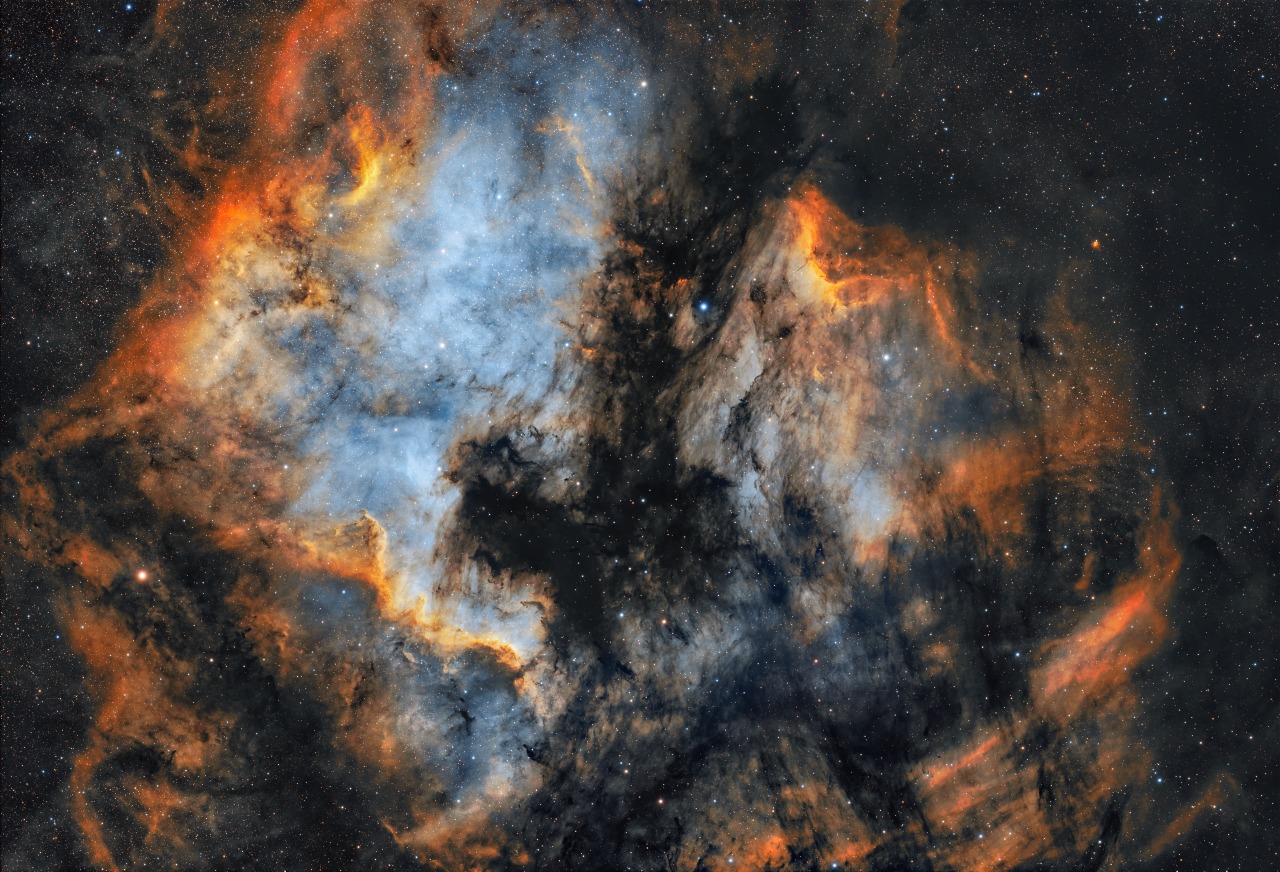
North America and Pelican Nebulae (NGC 7000, IC 5070)
Observation Summary
19-21 September 2022
32% -> 16.4%
20ʰ 58ᵐ 54ˢ / +44° 19′ 00″
≈ 4.0
≈ 120′ × 100′
Summary
H II Region
NGC 7000 – IC 5070
Northern
Cygnus
∼2,600 light-years
Technical Details
ZWO AM5
RedCat 51
ZWO ASI294MC Pro
IDAS NBZ
Svbony SV165
ZWO ASI220MM Mini
ZWO ASIAIR Plus
126 × 300"
10 h 30 min
PixInsight
Luxembourg
NGC 7000 & IC 5070: The North America and Pelican Nebulae – A Cosmic Tapestry of Star Formation
Hidden within the rich stellar fields of the Cygnus constellation, the North America Nebula (NGC 7000) and the Pelican Nebula (IC 5070) form one of the most active and scientifically valuable regions of star formation in our galaxy. Together, they make up a substantial portion of the larger H II region Sh2-117, located approximately 2,600 light-years from Earth (Reipurth & Schneider, 2008).
IC 5070 – The Pelican Nebula
First catalogued in the 1895 Index Catalogue by John Louis Emil Dreyer, the Pelican Nebula lies immediately adjacent to NGC 7000. Although visually separated by a dark lane of dust, Lynds Dark Nebula 935, it remains physically connected to its larger neighbour through a shared molecular cloud.
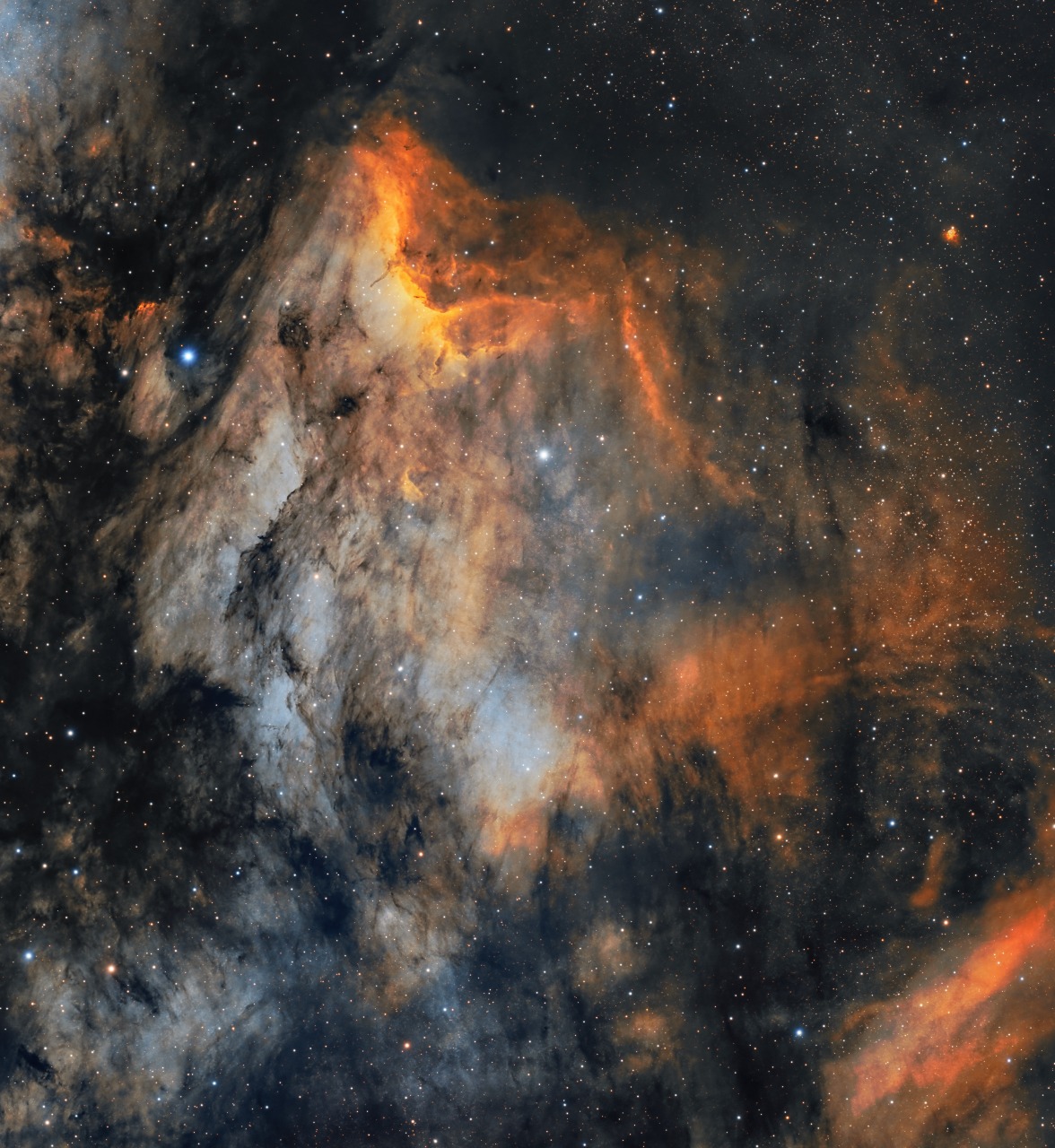
This nebula displays all the hallmarks of an active star-forming region: dust pillars, globules, ionised gas filaments, and photodissociation regions (PDRs), where ultraviolet radiation breaks apart molecular bonds. Observations suggest that both IC 5070 and NGC 7000 are influenced by the same ionising source: the embedded O3.5-type star 2MASS J20555125 +4352246.
Infrared surveys by Spitzer and Herschel have revealed a rich population of deeply embedded Young Stellar Objects (YSOs). Among these features is MHO 3400, a symmetric bipolar molecular outflow likely driven by a protobinary system.
X-ray studies confirm magnetic activity and accretion among these young stars. Gaia-based kinematic data show at least six coherent moving groups expanding through the interstellar medium, shaped by stellar winds and past energetic events.
As these massive stars evolve, their feedback will disperse the surrounding gas, eventually revealing newly formed star clusters, remnants of today’s star-forming processes.
NGC 7000 – The North America Nebula
Discovered in 1786 by William Herschel, NGC 7000 is named for its continent-like shape seen in wide-field images. It is a textbook H II region, glowing due to ionised hydrogen excited by ultraviolet radiation from massive stars. Spectroscopic studies detect Hα, [O III], and [S II] lines, while CO observations trace dense molecular clouds.
A particularly active area, the so-called “Gulf of Mexico”, is filled with embedded protostars, Herbig–Haro objects, and T Tauri stars, as seen in IR images from 2MASS, Spitzer, and Herschel. X-ray missions like Chandra and XMM-Newton have detected over 700 sources, mostly Class I–III YSOs.
Data from Gaia DR2 indicate several expanding stellar populations, likely shaped by winds or even past supernovae. Over millions of years, NGC 7000 will gradually disperse, leaving behind gravitationally bound clusters.
The Cygnus Wall
Located along the southeastern edge of NGC 7000, the Cygnus Wall is a towering structure of gas and dust roughly 20 light-years across. It marks the boundary between an ionised cavity and colder, denser molecular clouds.
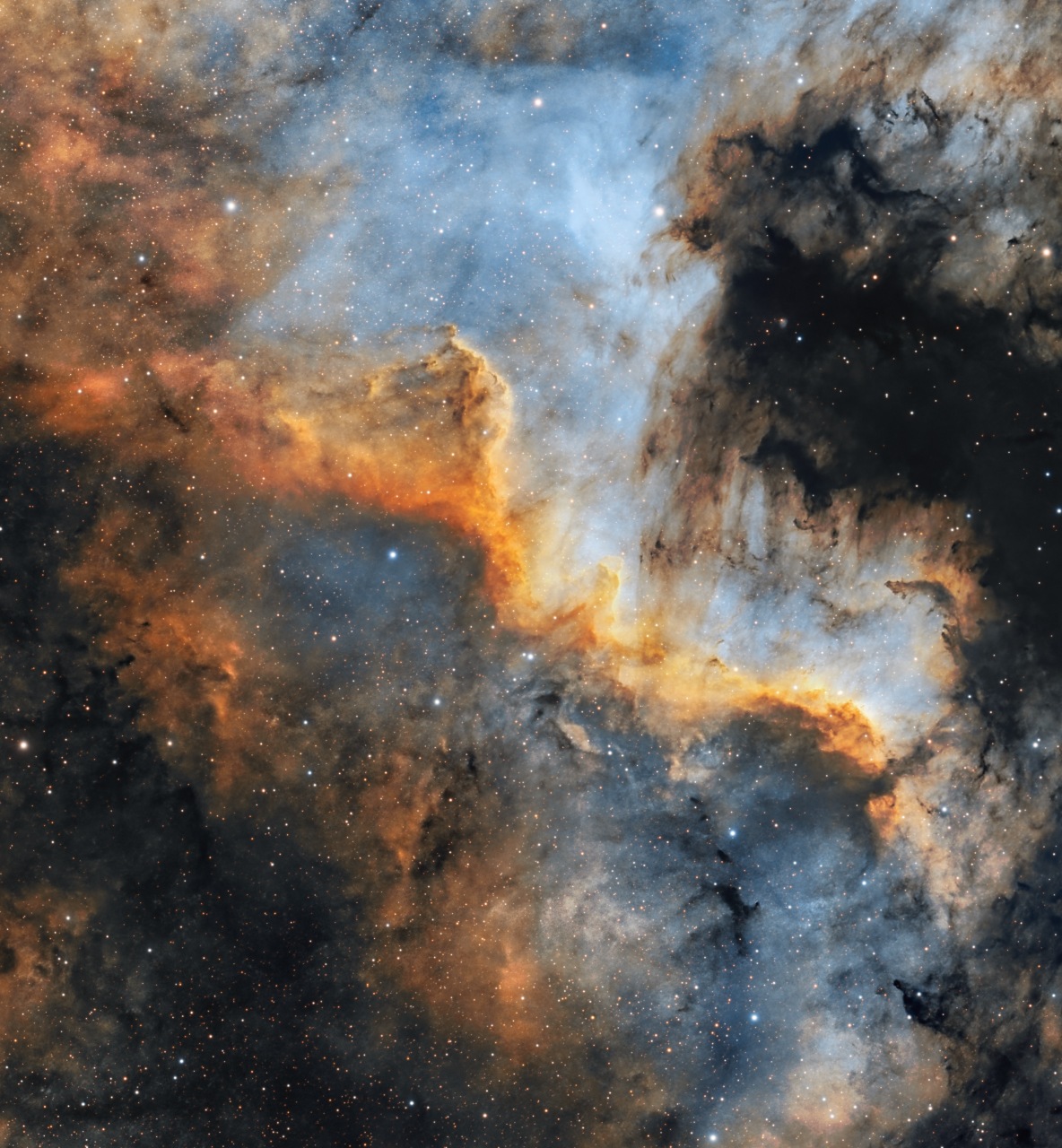
This wall is a prime example of a photodissociation region, where intense ultraviolet radiation drives photoevaporation and radiative compression, conditions ideal for forming new stars. Infrared observations reveal embedded Class 0 and I protostars and associated outflows.
Narrowband imaging in filters like Hα and S II showcases intricate contrasts between shock fronts, ionised gas, and dark globules. Its dynamic structure and vibrant colouration make it a favourite for both scientific research and astrophotography.
Observing NGC 7000 and IC 5070
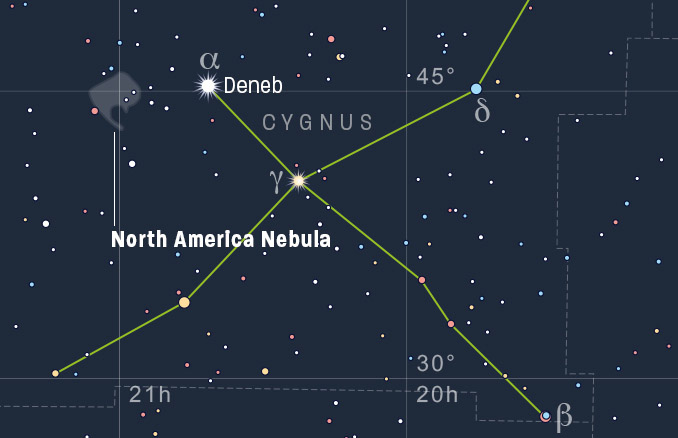
This region lies just east of Deneb (Alpha Cygni), the brightest star in Cygnus and a vertex of the Summer Triangle. While NGC 7000 sits directly east of Deneb, IC 5070 lies slightly southeast across the dark cloud L935. The entire complex spans over 4 degrees of sky—eight times the diameter of the full Moon—making it a superb target for wide-field imaging. Best observed between late June and early October, when Cygnus reaches its zenith in mid-northern latitudes.