
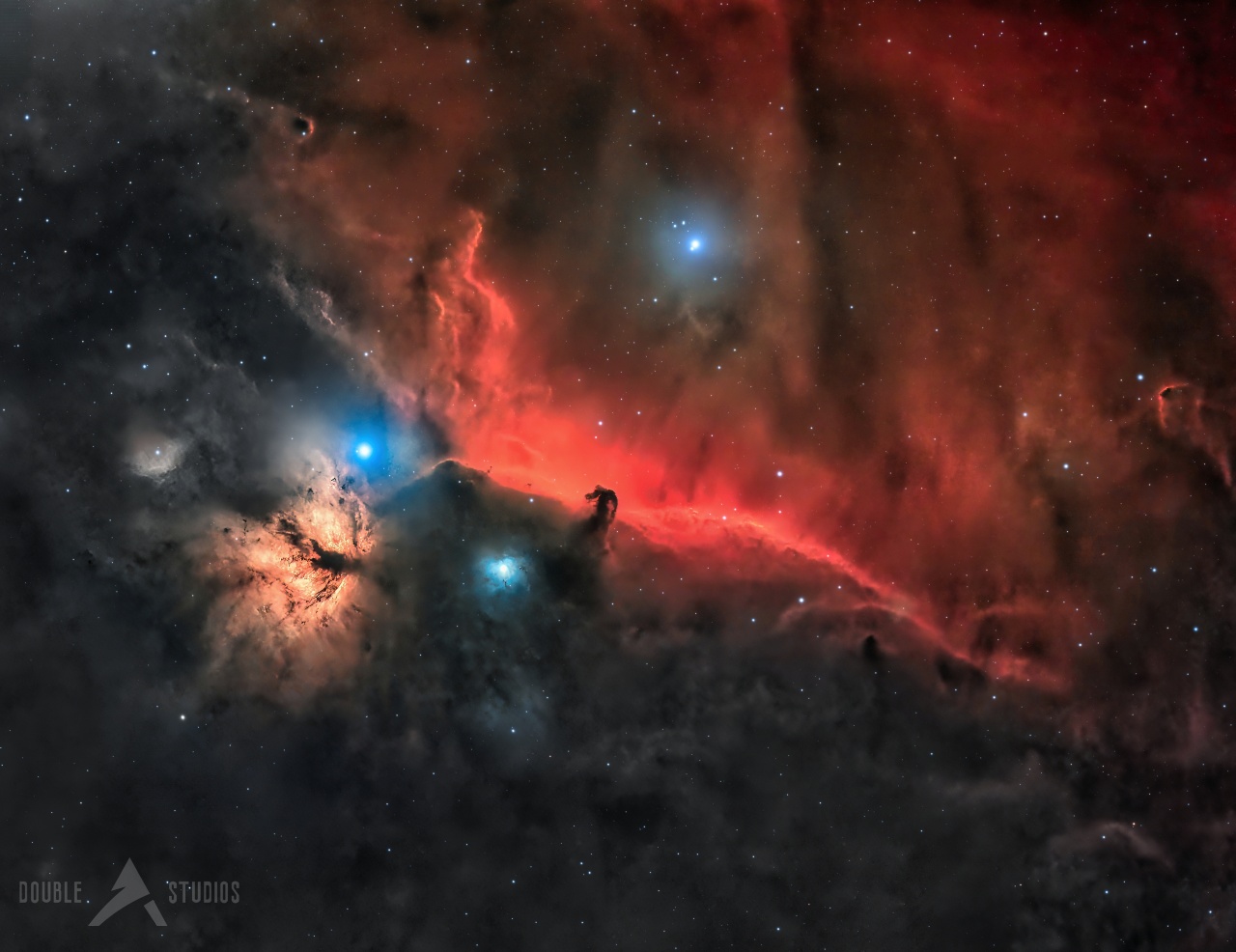
Horsehead Nebula (B 33)
Observation Summary
25 February 2022
38%
05h 41m 00s / −02° 27′ 00″
N/A
∼60′ × 30′ (combined Horsehead–Flame complex)
Summary
Dark nebula + emission nebula
Barnard 33 (Horsehead) – NGC 2024 (Flame)
Northern
Orion
∼1,000–1,500 light-years
Technical Details
Sky-Watcher HEQ5-Pro
William Optics ZS73EDII
ZWO ASI294MC-Pro
IDAS NBZ Dual Band
AstroEssential 50/200
ZWO ASI174MM
ZWO ASIAIR Plus
5 h
PixInsight
Luxembourg
Horsehead Nebula (Barnard 33): A cold pillar sculpted by radiation at the edge of Orion
The Horsehead Nebula, catalogued as Barnard 33 (B 33), is one of the most recognisable dark nebulae in the night sky. It appears as a sharply contoured silhouette set against the red glow of IC 434, a background curtain of ionised hydrogen. The Horsehead does not shine brightly on its own; it is visible because its dense dust and gas block light from behind.
That simple fact makes it more than a visual icon: it is a compact, nearby laboratory for studying how ultraviolet radiation from massive stars reshapes cold molecular clouds, carving sharp boundaries where chemistry and temperature change dramatically over tiny distances.
Astrophysically, B 33 sits at the boundary between the Orion B / L1630 molecular cloud (a reservoir of cold gas) and an illuminated environment powered by nearby massive stars. At this interface, the cloud’s surface is heated and eroded, while denser pockets can survive longer, sometimes approaching the conditions needed for gravitational collapse. Few objects show this interplay between destruction and survival with such clarity.
Early observations
The Horsehead’s “shape” is fundamentally a contrast feature, so it was first recognised through photography rather than at the eyepiece. It is widely credited to Williamina Fleming, who identified the nebula on Harvard College Observatory photographic plates in 1888. Later, Edward Emerson Barnard catalogued it as one of the Milky Way’s “dark markings” in his 1919 work, giving it the designation Barnard 33.
Barnard’s broader contribution was to establish that these dark shapes are not empty holes in the sky but real, light-blocking clouds. The Horsehead became one of the clearest demonstrations of that idea: a solid structure whose outline is drawn in negative, by the glowing gas behind it.
Distance and Galactic context
The Horsehead lies within the Orion Molecular Cloud Complex, among the nearest large star-forming regions to the Sun. In the specialist literature, the Horsehead’s distance is commonly treated as about 400 parsecs (roughly 1,300 light-years), consistent with its placement at the edge of the Orion B (L1630) cloud and with the geometry of the illuminated interface.
At this distance, the familiar “head” spans only a few light-years in height, and the sharp rim where the cloud meets the ionised environment corresponds to remarkably small physical scales. This proximity is a major part of the Horsehead’s scientific value: it allows astronomers to resolve the transition from ionised to molecular gas with exceptional detail and to test models of cloud-surface physics under strong irradiation.
Structure and composition
Barnard 33 is composed of cold molecular gas (dominated by H₂) mixed with dust grains that efficiently absorb and scatter visible light. The nebula’s crisp outline arises because a steep density gradient separates its dense interior from the lower-density surroundings, producing an abrupt change in extinction against the bright IC 434 background.
The most informative region is the illuminated edge: a narrow boundary where the cloud is exposed to ultraviolet light. High-resolution optical and infrared imaging shows that the “rim” is not smooth but structured into ridges, waviness, and small-scale substructure. This is the signature of an evolving interface: the surface is being heated, chemically processed, and slowly stripped away, while denser clumps resist erosion and can remain opaque.
The Horsehead is also a benchmark object for measuring how sharply the interstellar medium can transition between phases. Observations have shown that, in places, the change from warm, UV-processed material to cold, shielded molecular gas occurs over extremely small distances, making the region a stress test for models of gas heating, cooling, and chemistry.
Illumination and the Horsehead as a photon-dominated region
The Horsehead sits in front of IC 434, and its edge is irradiated primarily by the σ Orionis system, whose ultraviolet light both illuminates and erodes the cloud surface. This creates what astronomers call a photon-dominated region (PDR): a zone where far-ultraviolet photons control the chemistry and thermal balance of gas, driving reactions that would not proceed in dark, shielded environments.
The Horsehead PDR has become a reference target for astrochemistry because it is both nearby and geometrically clean. The illuminated edge is close to edge-on from our perspective, allowing researchers to map how different molecules peak at different depths as the UV field is absorbed. This has enabled detailed tests of chemical networks, dust properties, and the role of very small grains and complex carbon-bearing molecules in converting UV energy into heat.
In the past few years, new space-based observations have continued to exploit the Horsehead as a “standard candle” for PDR physics, connecting mid-infrared emission, molecular line surveys, and the fine-scale structure of the irradiated interface.
Star formation and internal stability
Despite its association with a major star-forming complex, the Horsehead itself is not dominated by vigorous star formation. Submillimetre observations have identified dense condensations within B 33, including compact cores often discussed in terms of their stability and evolutionary state. These structures demonstrate that the nebula contains material dense enough to be interesting gravitationally, but the overall region does not host the kind of rich embedded cluster seen elsewhere in Orion.
This makes the Horsehead scientifically useful in a different way: it shows that strong irradiation and striking morphology do not automatically imply rapid star formation. Instead, the Horsehead highlights the importance of local conditions—density structure, external pressure, and the balance between erosion and collapse—in determining whether a cloud turns into stars or is gradually dispersed.
Future evolution
The Horsehead is not a permanent fixture. Ultraviolet radiation heats the cloud’s surface layers and drives photo-evaporative flows, slowly removing mass from the exposed rim. Over time, this process will thin and reshape the structure, softening its sharp outline and fragmenting the most exposed features. The densest parts will survive longest, but continued erosion will ultimately disperse the cloud into the surrounding interstellar medium.
Timescales depend on the local UV field and density distribution, but the qualitative trajectory is clear: the Horsehead is an example of how molecular clouds can be sculpted and destroyed by nearby massive stars, contributing processed gas and dust back into the Orion environment. In Galactic ecology terms, it is not only the “birth” of stars that matters, but also the continual reshaping and recycling of the raw material from which future stars will form.
Observing the Horsehead Nebula
The Horsehead is located in Orion, immediately south of Alnitak (ζ Orionis), the easternmost star of Orion’s Belt. Although the region is easy to point to, the nebula is not a casual visual target: it has low contrast and is seen mainly as a notch cut into the faint glow of IC 434.
For visual observing, success usually requires dark, transparent skies, sufficient aperture, and a filter strategy that enhances the faint emission of IC 434. Many experienced observers use a hydrogen-beta (Hβ) filter, which can increase contrast for the IC 434 background and make the Horsehead’s silhouette easier to detect as a subtle indentation rather than a crisp “horse” shape.
For imaging, the situation is very different. Hydrogen-alpha data quickly reveal IC 434 and outline the Horsehead as a strong absorption feature, while broadband colour adds star colour and dust tone. Infrared observations can partially penetrate the dust, showing internal structure not visible in optical wavelengths.
In the Northern Hemisphere, Orion is best placed from late autumn through winter, when it climbs high in the evening sky.
References (peer-reviewed and authoritative)
- Fleming, W. P. (1888). Horsehead discovery on Harvard photographic plates (Harvard Plate Stacks historical documentation).
- Barnard, E. E. (1919). On the dark markings of the sky, with a catalogue of 182 such objects. Astrophysical Journal.
- Abergel, A. et al. (2003). ISOCAM and molecular observations of the edge of the Horsehead nebula. Astronomy & Astrophysics, 410, 577–585.
- Habart, E. et al. (2005). Density structure of the Horsehead nebula photodissociation region. Astronomy & Astrophysics. (Includes the widely used ~400 pc distance context and edge-on PDR geometry.)
- Ward-Thompson, D. et al. (2006). SCUBA observations of the Horsehead nebula. Monthly Notices of the Royal Astronomical Society. (Dense cores and submillimetre structure; uses canonical distance framework.)
- Abergel, A. et al. (2024). JWST observations of the Horsehead photon-dominated region. Astronomy & Astrophysics.