
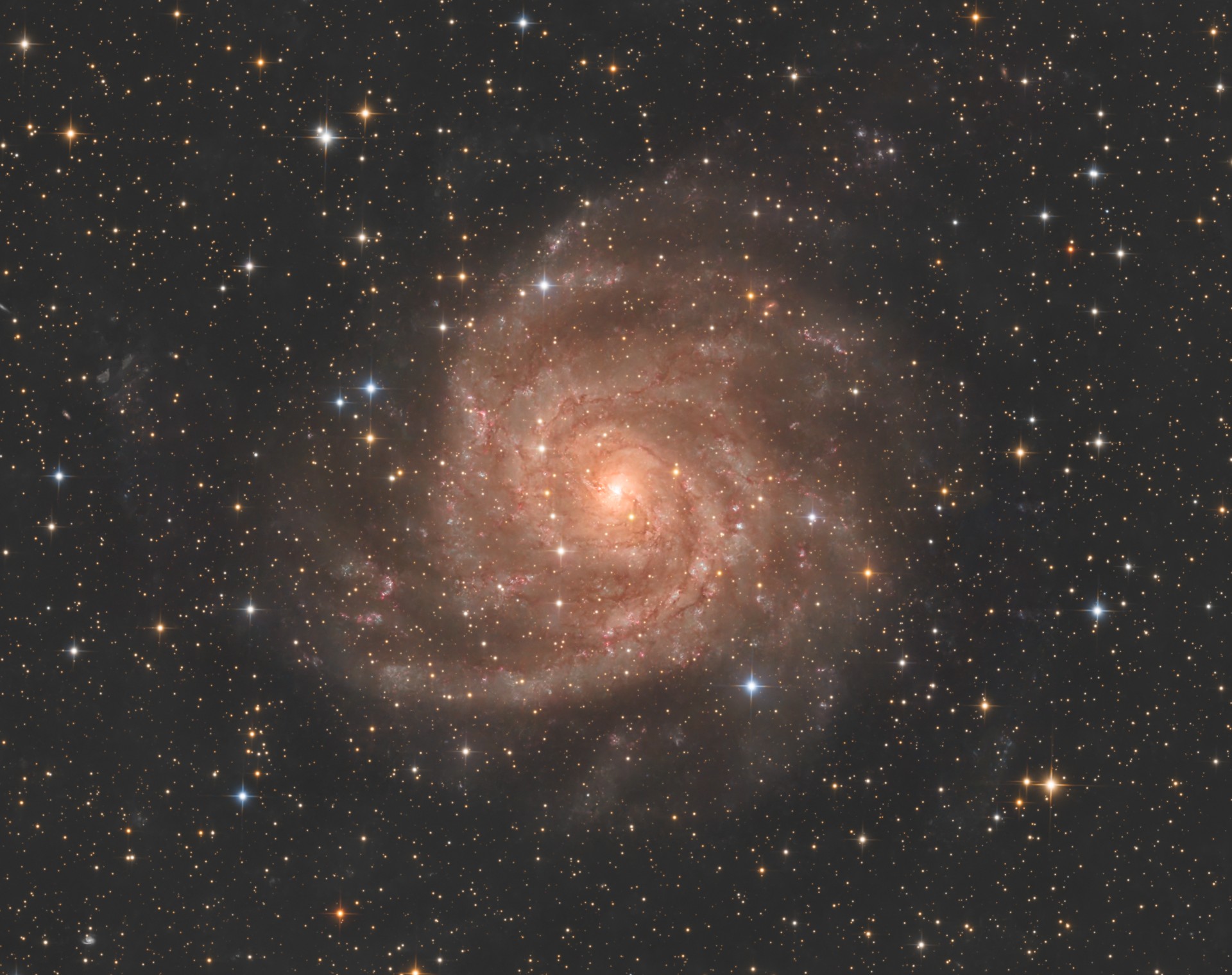
The Hidden Galaxy (IC 342)
Observation Summary
21 November 2025
1%
03h 46m 52.1s / +68° 05′ 49.3″
∼8.4 – 9.1
In a Nutshell
Intermediate spiral galaxy (SAB(rs)cd)
IC 342, Caldwell 5
Northern
Camelopardalis
∼11 million light-years
Technical Details
ZWO AM5
Technosky Astrograph Carbon RC 6" F/8
ZWO ASI2600MC (IMX571)
Optolong LQEF
Askar OAG
ZWO ASI220MM-Mini
ASIAIR Plus
118x300"
9 h 50 m
PixInsight
Luxembourg
The Hidden Galaxy in Camelopardalis
IC 342, often nicknamed the Hidden Galaxy, is a nearby spiral galaxy partly obscured by the dust and stars of the Milky Way’s disc. Despite being intrinsically bright and relatively close on a cosmological scale, its low surface brightness and position near the Galactic plane make it a challenging object for visual observers — and a fascinating case study for professional astronomers.
Discovery and Early Observations
IC 342 entered the astronomical record during the late 19th-century wave of deep-sky cataloguing. In August 1890, American astronomer E. E. Barnard noted a faint nebulous patch in Camelopardalis on his photographic plates but did not formally publish the discovery. A few years later, British amateur astronomer William Frederick Denning independently observed the same object. The entry in John Dreyer’s Index Catalogue (1895) credits Denning as the discoverer, and the galaxy has carried the designation IC 342 ever since. :contentReference[oaicite:1]{index=1}
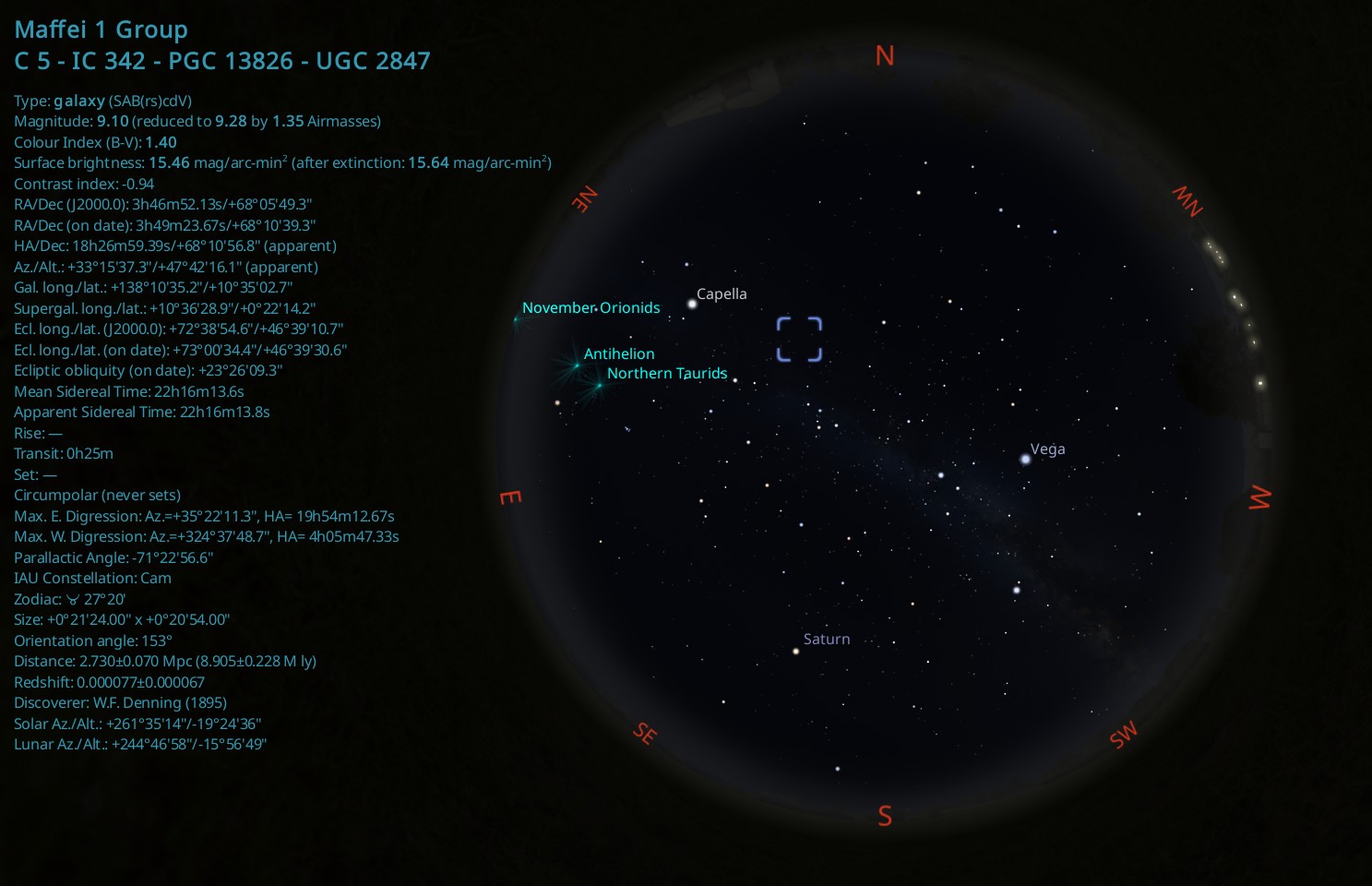
Even early on, observers realised that IC 342 was unusual. It appeared large in angular size but faint in surface brightness — a combination that hinted at significant foreground extinction. In the first half of the 20th century, Edwin Hubble initially considered IC 342 a possible member of the Local Group because of its apparent size and brightness, before more accurate distance estimates showed that it lies well beyond it. By the 1930s, Harlow Shapley had drawn attention to its Moon-like angular diameter on the sky, further underlining that this was a substantial galaxy whose light was being heavily dimmed by interstellar dust. :contentReference[oaicite:2]{index=2}
The combination of large physical scale, relatively small distance, and strong foreground obscuration eventually led to its popular nickname: the Hidden Galaxy. Were it not buried behind the Milky Way’s dust clouds, IC 342 would likely be one of the most conspicuous spirals in our sky. :contentReference[oaicite:3]{index=3}
Main Characteristics
IC 342 is classified morphologically as an intermediate spiral galaxy of type SAB(rs)cd: a late-type spiral with a weak central bar and loosely wound arms. Current distance estimates based on various standard-candle methods place it at roughly 3.3 Mpc, or about 10–11 million light-years from Earth, with values in the literature clustering around this range. :contentReference[oaicite:5]{index=5}
In three-dimensional space, IC 342 is one of the dominant members of the IC 342/Maffei Group, a nearby group of galaxies just beyond the Local Group. :contentReference[oaicite:6]{index=6} Estimates of its stellar disc size suggest a diameter of order 50,000–75,000 light-years, making it somewhat smaller than the Milky Way but still a massive spiral system. :contentReference[oaicite:7]{index=7} Its total stellar population is on the order of 1011 stars, comparable to large spiral galaxies in the local universe.
Photometrically, IC 342 has an integrated visual magnitude of about 9.1, though some catalogues quote values as bright as approximately 8.4 depending on bandpass and corrections. :contentReference[oaicite:8]{index=8} On the sky it spans roughly 21 arcminutes, about two-thirds of the apparent diameter of the full Moon. The faintness that most observers experience is not due to a lack of intrinsic brightness, but to the heavy reddening and dimming caused by the Milky Way’s intervening dust along this line of sight.
IC 342 is oriented almost face-on, offering a clear view of its disc and spiral arms, rather than the edge-on perspective we have for many other nearby spirals. This geometry, combined with its proximity, makes it a valuable analogue for galaxies like our own — essentially a “nearby laboratory” for studying the structure and evolution of a Milky Way-like system. :contentReference[oaicite:10]{index=10}
Structure and Composition
Imaging across optical, infrared, and radio wavelengths reveals a luminous central region surrounded by multiple spiral arms. High-resolution observations with Hubble and large ground-based telescopes show dust lanes and H II regions tracing the arms, highlighting sites of ongoing star formation. :contentReference[oaicite:11]{index=11}
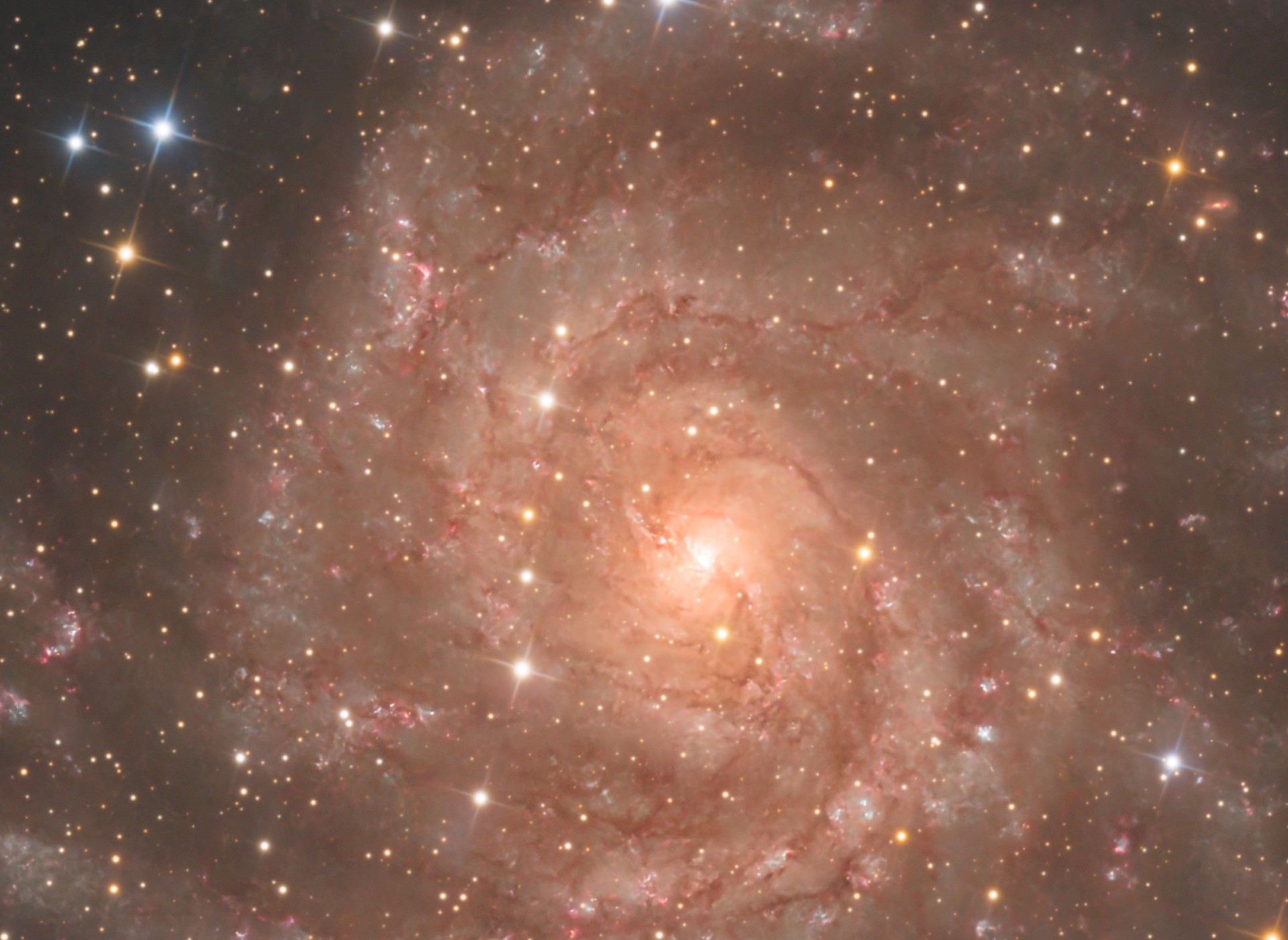
The nucleus of IC 342 is particularly active. It hosts a circumnuclear ring of molecular gas, analogous to the Milky Way’s central molecular zone. Spectroscopic observations with facilities such as SOFIA/GREAT have mapped emission from ionised carbon and nitrogen in this region, finding that much of the gas is already heated and ionised by young, massive stars. This supports the interpretation of IC 342’s core as a mild nuclear starburst, where a recent episode of intense star formation has energised much of the central gas reservoir. :contentReference[oaicite:12]{index=12}
Morphologically, IC 342 shows a small central bar that helps to funnel gas inward, feeding the nuclear region, while the inner disc displays a partial ring structure (the “rs” in SAB(rs)cd). The spiral arms themselves are clumpy and rich in dust and young stellar associations. Multi-wavelength imaging shows a colour gradient: the inner regions are dominated by older, redder stellar populations and dust, whereas the outer arms are bluer, tracing younger populations and star-forming complexes. :contentReference[oaicite:13]{index=13}
In terms of gas content, IC 342 is a gas-rich spiral. CO and H I surveys show large reservoirs of molecular and atomic hydrogen distributed across the disc, with concentrations along the bar and the major spiral arms. These gas reservoirs are the fuel for the galaxy’s present and future star formation. :contentReference[oaicite:14]{index=14}
Stellar Population
Like other massive spirals, IC 342 hosts a mix of stellar populations of different ages and metallicities. The bulge and inner disc are dominated by older, metal-rich and metal-poor stars that emit strongly in the red and near-infrared. The spiral arms, by contrast, contain numerous OB associations, open clusters, and H II regions representing recent star formation over the last few tens of millions of years. :contentReference[oaicite:15]{index=15}
Deep imaging with the Euclid space telescope has given a new view of IC 342 at near-infrared wavelengths, where foreground dust is far less disruptive. Euclid’s early-release images resolve the galaxy’s disc into countless cool, red stars and highlight large numbers of star clusters and candidate globular clusters, reinforcing the idea that IC 342 is a close structural analogue of the Milky Way viewed face-on. :contentReference[oaicite:16]{index=16}
In the more extended halo, observers have identified a population of globular clusters, tracing the early assembly history of the galaxy. These ancient clusters, with ages of around 10–13 billion years, orbit in the halo much as they do around the Milky Way. At the very centre, high-resolution Hubble data resolve a compact nuclear star cluster, embedded within the gas-rich nuclear region. :contentReference[oaicite:17]{index=17}
For a long time IC 342 appeared to lack obvious dwarf companions, unlike the Milky Way or Andromeda. More recent work has identified at least one confirmed satellite, the faint dwarf spheroidal galaxy KKH 22, likely bound to IC 342 as part of its small group environment. :contentReference[oaicite:18]{index=18}
Star Formation and Future Evolution
Current observations show that IC 342 is undergoing significant star formation, especially in its central regions and along its spiral arms. The nucleus is classified as an H II nucleus, dominated by emission from gas ionised by young stars rather than by a luminous active galactic nucleus. :contentReference[oaicite:19]{index=19} Far-infrared diagnostics from SOFIA indicate that much of the central gas has been heated by this starburst episode, suggesting that the galaxy has recently converted a substantial fraction of its nuclear gas into stars. :contentReference[oaicite:20]{index=20}
Across the disc, narrowband Hα imaging highlights numerous H II regions distributed along the arms, marking a fairly high star-formation rate for a galaxy of this type. Radio and millimetre-wave maps of CO emission confirm the presence of dense molecular clouds in these regions, supporting a continuous cycle of cloud collapse and star birth. :contentReference[oaicite:21]{index=21}
Interestingly, there are no confirmed supernovae recorded in IC 342 to date, despite its active star formation and large population of massive stars. This may simply reflect chance and limited monitoring, and/or the fact that any supernova light curves would be dimmed and reddened by the same dust that obscures the galaxy as a whole. :contentReference[oaicite:22]{index=22}
Looking ahead, IC 342 is expected to continue forming stars for hundreds of millions of years, as long as its gas reservoirs persist. The central starburst is likely to evolve as feedback from massive stars — stellar winds, radiation pressure, and eventual supernova explosions — heats and disperses some of the gas. On longer timescales, the galaxy may settle into a more quiescent phase as its gas content is gradually depleted or stabilised. Given its relatively quiet group environment, major mergers are not expected in the near future, so IC 342’s evolution may be broadly similar to that of the Milky Way: gradual, secular, and driven by internal dynamics and minor interactions.
Recent Research Highlights
IC 342 has been the focus of numerous multi-wavelength campaigns. In X-rays, observations by Chandra and NuSTAR have identified a pair of ultraluminous X-ray sources (ULXs) in the galaxy’s disc. These are off-nuclear, extremely bright X-ray emitters, thought to be powered by accreting compact objects — most likely stellar-mass black holes or neutron stars, though the possibility of intermediate-mass black holes remains under study. :contentReference[oaicite:23]{index=23}
In the far-infrared and submillimetre, SOFIA/GREAT and other facilities have mapped key cooling lines such as [C II] and [N II] in the central regions, constraining the physical conditions of the star-forming gas and confirming that the nucleus is dominated by stellar feedback rather than an active galactic nucleus. :contentReference[oaicite:24]{index=24} Millimetre-wave interferometers (e.g. NOEMA/IRAM) have traced CO emission across the disc, revealing how gas flows along the bar and arms into dense star-forming complexes. :contentReference[oaicite:25]{index=25}
Most recently, ESA’s Euclid mission has provided a dust-penetrating view of the galaxy in the near-infrared, resolving individual stellar populations, clusters, and globular clusters across the entire disc. :contentReference[oaicite:26]{index=26} These data are now being used to reconstruct the star-formation history and structural evolution of IC 342 in far greater detail than was previously possible, reinforcing its status as a key comparison object for understanding spiral galaxies in the nearby universe.
Observing IC 342 from Earth
For observers on the ground, IC 342 remains true to its nickname. Its integrated magnitude of around 9 belies a very low surface brightness, because its light is spread over a large area and heavily dimmed by foreground dust. Even under dark skies, small binoculars typically show little more than a vague brightening, and many observers require at least a medium-sized telescope and excellent transparency to detect it reliably. :contentReference[oaicite:27]{index=27}
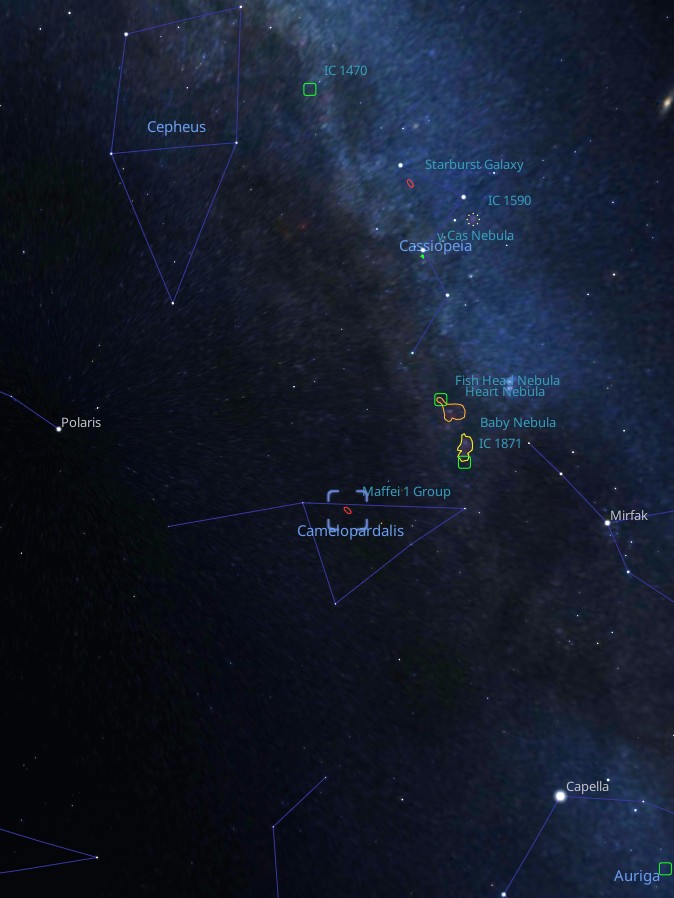
The galaxy lies in the faint northern constellation Camelopardalis. A practical star-hopping route for mid-northern observers is to start from the familiar “W” of Cassiopeia and move northwards into Camelopardalis. The 6th-magnitude red variable BE Camelopardalis lies close to IC 342’s position and is often used as a reference in detailed finder charts. :contentReference[oaicite:28]{index=28}
IC 342 is circumpolar for much of the northern hemisphere and can, in principle, be observed throughout the year, but it is best placed during the autumn and winter months when it is highest in the sky at night. Around November it reaches opposition and culminates near local midnight, giving the best chance for a high-altitude, low-airmass view. :contentReference[oaicite:29]{index=29}
Low- to medium-power eyepieces are generally most effective, as they frame the full disc and enhance contrast against the background. Any haze, moonlight, or light pollution will quickly erase this object from view, so truly dark skies are essential. For astrophotographers, IC 342 is an excellent but demanding target: long total integration times and careful background processing are required to bring out its delicate spiral arms and dusty structure through the foreground veil of the Milky Way.