
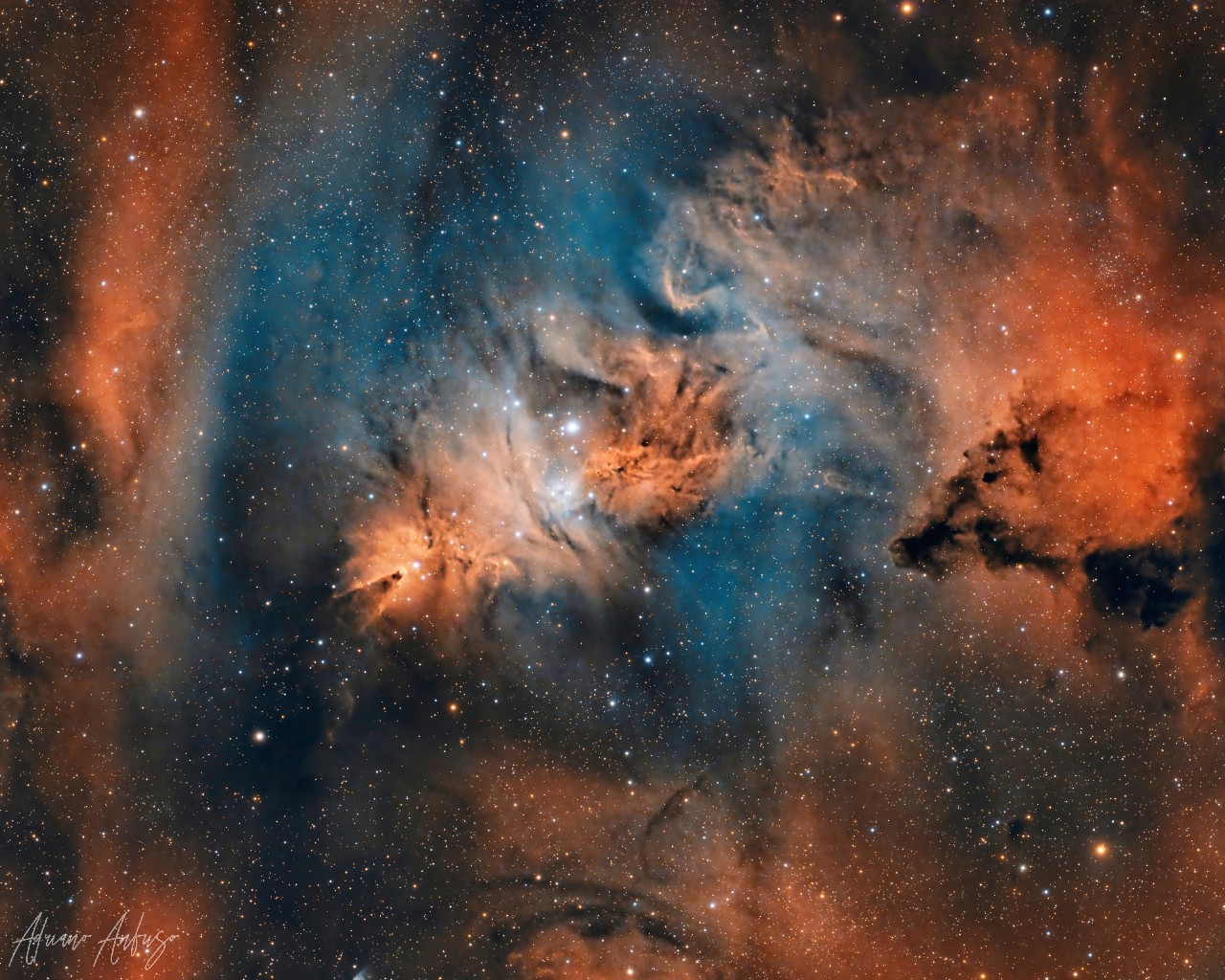
Christmas Tree Complex (NGC 2264)
Observation Summary
12 February 2023
57%
06h 41m 00s / +09° 53′ 00″
∼3.9 (cluster; nebula has low surface brightness)
∼60′ × 60′
Summary
Open cluster / Emission nebula
NGC 2264
Northern
Monoceros
∼2,500 light-years
Technical Details
ZWO AM5
RedCat 51
ZWO ASI294MC-Pro
Optolong L-Ultimate 3 nm
Svbony SV165 30/120
ZWO ASI220MM Mini
ZWO ASIAIR Plus
6 h 20 min
PixInsight
Luxembourg
Galactic festivities with NGC 2264
This region of space, located approximately 2,700 light-years away in the constellation Monoceros, is both scientifically significant and visually striking as an active star-forming area. Known as the Christmas Tree Complex, it takes its name from its characteristic shape, which resembles a decorated tree. The complex includes several prominent features, such as the Cone Nebula, the Fox Fur Nebula, and an intricate network of surrounding reflection and emission nebulae, all contributing to its dynamic appearance.

The cluster resides within a dense molecular cloud, the raw material for star formation. Within this environment, gravitational forces compress pockets of gas and dust, triggering the formation of protostars. Many of these stars are in the earliest stages of their evolution, ranging in age from a few tens of thousands to several million years. These young stars emit intense ultraviolet radiation, which shapes their surroundings and can even stimulate additional star formation in neighbouring regions (Megeath et al., 2016).
A particularly striking feature of the complex is the Cone Nebula, a towering column of gas and dust extending approximately seven light-years. Its distinctive shape is sculpted by stellar winds and radiation pressure from massive young stars in the cluster, which erode the surrounding material. These interactions provide valuable insights into how massive stars influence their environments, halting star formation in some areas while simultaneously triggering it elsewhere (Bally et al., 2018).
The reddish hues are typical of ionized hydrogen gas, which glows when excited by the ultraviolet light of the hot, young stars. In contrast, the blue regions are created by starlight scattered by fine dust particles. Such combination of colours offers critical information about the composition and physical conditions of the interstellar medium (NASA Herschel Mission Archives).
Studies of NGC 2264 using spectroscopic techniques and infrared observations have uncovered intricate details about the region's chemical composition and dynamics. Molecules such as carbon monoxide (CO) and formaldehyde (H2CO) are present in significant quantities, providing important clues about the processes driving star formation (Davis et al., 2015).

Regions like NGC 2264 are vital laboratories for understanding stellar evolution. Open clusters such as this are crucial for studying how stars form, evolve, and interact with their surroundings. Over time, the loosely bound stars of the Christmas Tree Cluster will drift apart and become part of the galactic field population. Observations of clusters like this offer a valuable snapshot of the early stages of stellar and cluster evolution (Megeath et al., 2016).
The Christmas Tree Complex has been the focus of extensive studies using advanced space-based observatories such as the Spitzer Space Telescope and the Herschel Space Observatory. These missions have identified hundreds of young stellar objects (YSOs) within the central cluster, each contributing to our understanding of the formation of stars and planetary systems (NASA Spitzer Mission Archives).
According to a 2016 study published in The Astrophysical Journal, “The Christmas Tree Cluster exemplifies the feedback-driven dynamics of star formation, where the radiation from massive stars sculpts the surrounding medium, setting the stage for future stellar generations” (Megeath et al., 2016).

NGC 2264 is best observed during the winter months in the Northern Hemisphere, with peak visibility between December and February when the constellation Monoceros is high in the night sky. Monoceros, located near the prominent constellations of Orion and Gemini, lies just east of Betelgeuse, the bright red supergiant in Orion. For amateur astronomers, a dark-sky location away from urban light pollution is essential to fully appreciate the faint nebulosity of this complex.