
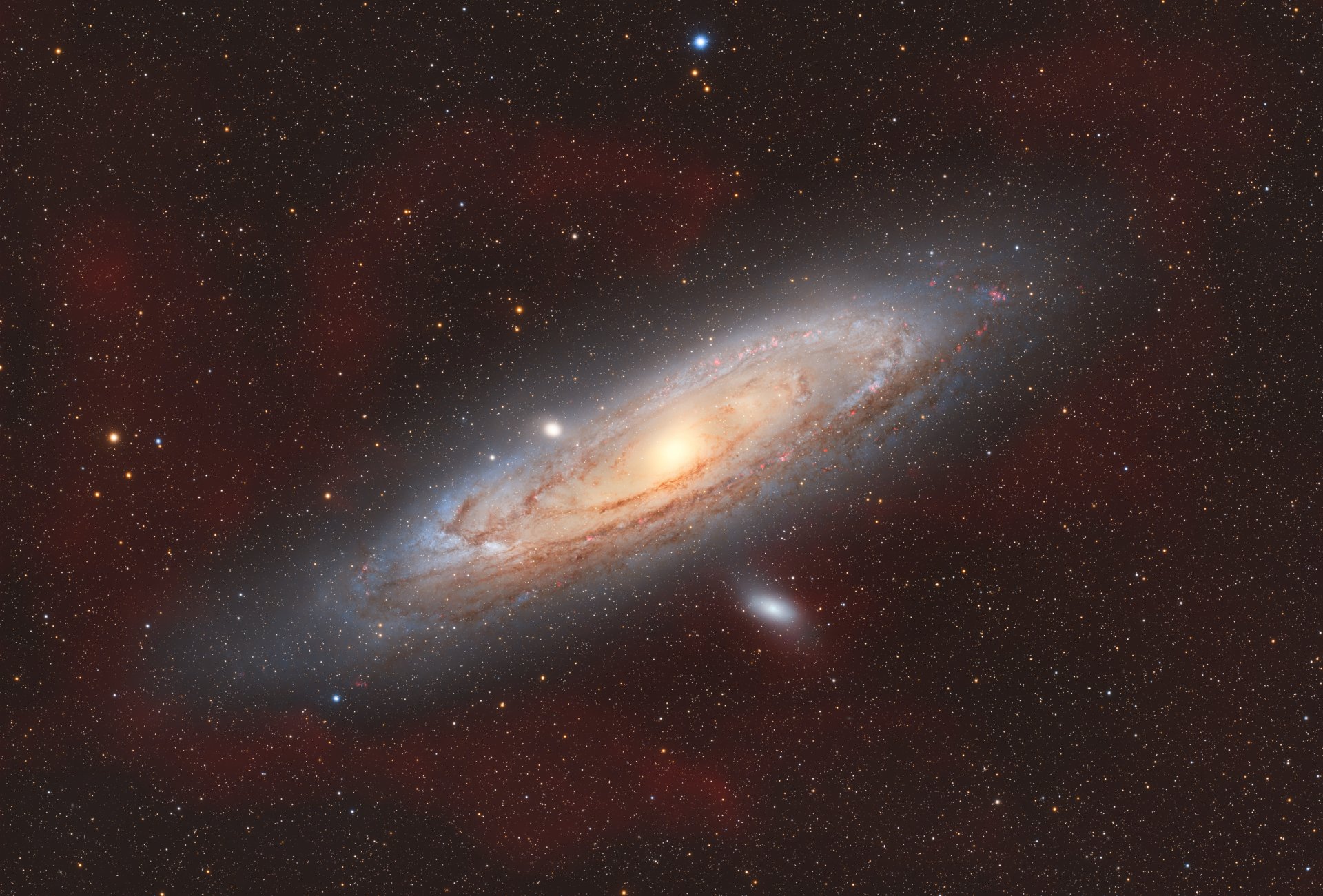
Andromeda Galaxy (M31)
Observation Summary
22 Aug - 10 Sept 2023
34% -> 100% -> 22.7%
00ʰ 42ᵐ 44.3ˢ / +41° 16′ 09″
≈ 3.4
≈ 190′ × 60′
Summary
Spiral Galaxy (SA(s)b)
M31 / NGC 224
Northern
Andromeda
≈ 2.54 million light-years
Technical Details
ZWO AM5
RedCat 51
ZWO ASI294MC-Pro
Optolong L-Pro + L-Ultimate
WO Uniguide 32
ZWO ASI220MM Mini
ZWO ASIAIR Plus
L-Pro: 498x300"
L-Ultimate: 154x300"
54 h 30 min
PixInsight
Luxembourg
The Andromeda Galaxy (M31) and the enigma of its faint Hα veil
The Andromeda Galaxy, also known as Messier 31 (M31), is the nearest large spiral galaxy to our own Milky Way. At a distance of about 2.5 million light-years, it is the most distant object routinely visible to the naked eye and the dominant member of the Local Group.
Yet despite centuries of observation, Andromeda still holds subtle mysteries — among them the origin of extremely faint hydrogen-alpha (Hα) emission sometimes detected around its outskirts.
Andromeda was first described in the 10th century by the Persian astronomer Abd al-Rahman al-Sufi as a “small cloud”. It entered modern astronomy with Charles Messier’s catalogue in 1764, but its true nature remained uncertain until the 1920s. By identifying Cepheid variable stars in M31, Edwin Hubble demonstrated that it lies far beyond the Milky Way, establishing the existence of other galaxies and fundamentally changing our understanding of the Universe.
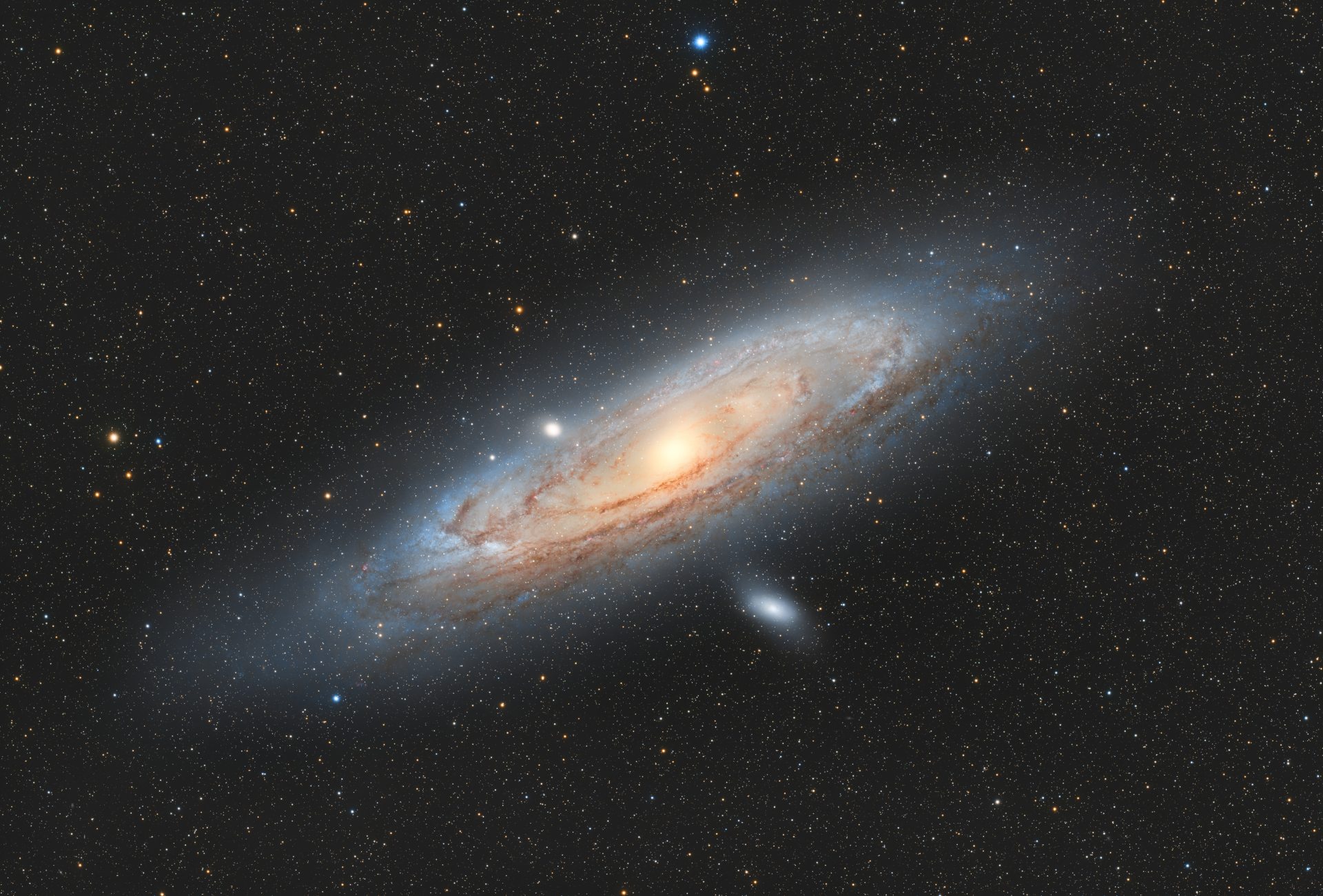
M31 is a massive SA(s)b spiral galaxy with an estimated diameter exceeding 200,000 light-years, making it larger than the Milky Way. It contains on the order of a trillion stars and a total mass of roughly one trillion solar masses when dark matter is included. A bright central bulge, extensive spiral arms rich in dust, and a vast stellar halo define its structure.
The visible disc of Andromeda hosts spiral arms marked by dust lanes and star-forming regions, where young, hot stars ionise surrounding hydrogen gas. These regions glow strongly in Hα light and are easily revealed with narrowband imaging. Surrounding the disc is a large stellar halo composed primarily of old stars, globular clusters, and tidal streams — the remnants of past mergers.
Beyond the stars lies a much more elusive component: a diffuse, extended envelope of gas known as the circumgalactic medium (CGM). Ultraviolet absorption studies using background quasars have shown that this halo of ionised gas extends for more than a million light-years around Andromeda.
Hydrogen-alpha emission occurs when ionised hydrogen recombines and emits light at a wavelength of 656.3 nanometres. In galaxies, it is most commonly associated with star-forming regions, but it can also trace extremely diffuse ionised gas in galactic halos. Detecting such emission at very low surface brightness pushes both professional and amateur observations to their limits.
The faint Hα structures: signal or illusion?
Deep, wide-field Hα images of Andromeda sometimes reveal very faint, large-scale reddish structures surrounding or overlapping the galaxy. At first glance, these features may appear to form a vast Hα “cloud” or veil encasing M31. However, interpreting these structures is exceptionally challenging.
Recent research has shown that some prominent arc-like emission features seen in deep images toward Andromeda are not associated with M31 at all. Spectroscopic follow-up and velocity measurements indicate that certain structures are instead ionised gas filaments within our own Milky Way, projected along the same line of sight. This foreground emission can convincingly mimic a galactic halo when observed in narrowband images alone.
For an Hα feature to be confidently linked to Andromeda, astronomers must demonstrate that its radial velocity matches that of M31 rather than local Galactic gas. Without this kinematic confirmation, morphology alone is insufficient. As a result, while Andromeda unquestionably possesses an enormous ionised gas halo, its direct detection in Hα emission remains uncertain and at the frontier of observational capability.
There is no doubt that Andromeda is embedded in a massive, ionised circumgalactic medium. This halo contains hydrogen and heavier elements expelled by stellar winds, supernovae, and past merger events. What remains unclear is whether this gas emits Hα strongly enough to be mapped directly in emission over large angular scales, or whether most reported detections are dominated by foreground contamination and instrumental artefacts.
Recent discoveries
Over the past five years, major surveys have transformed our understanding of M31. Deep imaging with the Hubble Space Telescope has resolved hundreds of millions of stars across its disc and halo. Meanwhile, modelling of its stellar populations reveals that Andromeda likely experienced a significant merger around two to three billion years ago, triggering a galaxy-wide burst of star formation.
At the same time, new wide-field optical surveys and ultra-deep narrowband observations are probing the low-surface-brightness Universe with unprecedented sensitivity. These efforts aim to disentangle genuine extragalactic emission from foreground structures and to test whether galaxies like Andromeda can be directly imaged in Hα far beyond their stellar discs.
Andromeda and the Milky Way are moving toward each other and are expected to interact in several billion years. Whether this results in a direct collision or a more complex dynamical encounter remains an active area of research. If a merger occurs, it will reshape both galaxies and dramatically alter their gaseous halos.
Observing Andromeda
M31 lies in the constellation Andromeda, near the Great Square of Pegasus. From mid-northern latitudes, it is best observed from late summer through winter, when it climbs high in the evening sky. Under dark conditions, it appears as an elongated, diffuse glow several times the apparent diameter of the full Moon.
Visually, Andromeda is best appreciated with binoculars or small telescopes under dark skies. Imaging its faint outskirts — and any putative Hα structures — requires exceptional care: precise flat-fielding, rigorous gradient control, and sceptical interpretation. Ultra-faint emission near the detection limit demands confirmation through independent datasets and, ideally, spectroscopy.
References
- Lehner, N. et al., 2015, The Baryonic Halo of Andromeda, Astrophysical Journal
- D’Souza, R. & Bell, E. F., 2018, The Andromeda Galaxy’s Past Major Merger, Nature Astronomy
- Hammer, F. et al., 2018, A Major Merger Scenario for M31, Monthly Notices of the Royal Astronomical Society
- Lumbreras-Calle, A. et al., 2025, Foreground Ionised Gas Toward M31, Astronomy & Astrophysics
- NASA / ESA Hubble Space Telescope Collaboration, 2024–2025, Andromeda surveys and halo studies